About Cyperus polystachyos Rottb.
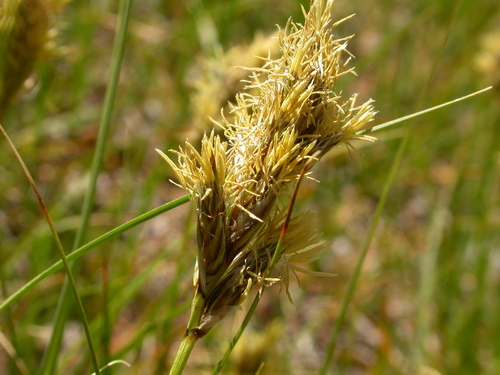
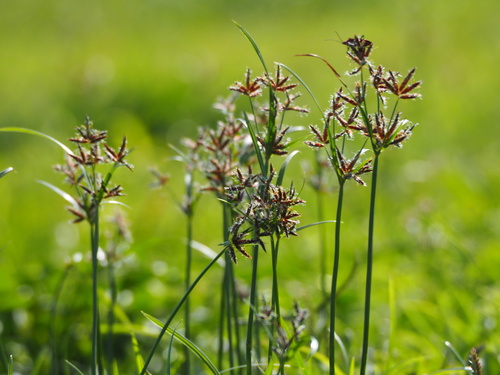
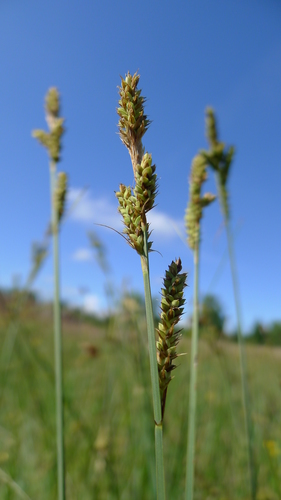
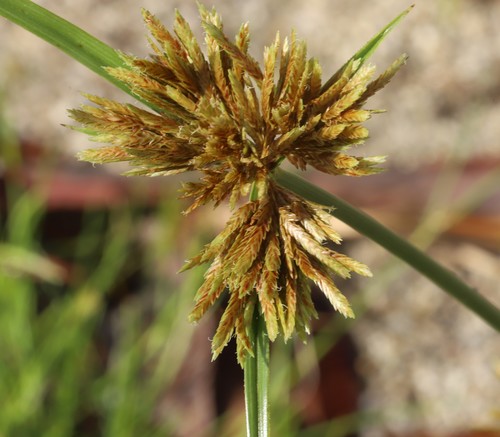
Cyperus polystachyos Rottb. is a rhizomatous, grass-like sedge that can be perennial or annual. It usually grows to a height of 0.15 to 0.6 metres (0.5 to 2.0 ft). Its rigid, glabrous stems have a triangular cross-section and are 1 to 3 millimetres (0.039 to 0.118 in) thick. The leaves are very narrow, around 1 to 4 mm (0.039 to 0.157 in) wide, have a grass-like appearance, and are often tufted at the base of the plant. It blooms between summer and winter, producing green-brown flowers. The seed-head forms an irregular cluster at the tip of the stem, with brown spikes and three to six green leafy bracts underneath the cluster. In the Neotropics, this species is common as a weed in grass lawns. In Australia, it is widespread in warmer climates, found from sea level up to an altitude of approximately 1,020 metres (3,346 ft). It grows along rivers and creeks across a range of ecosystems, including rainforest, melaleuca forest, vine thickets, eucalypt forest, swamps, various woodland and grassland areas, as well as salty mud and marshes on the ocean shore. In Australia, it occurs mostly in coastal locations, found north of Perth in Western Australia, and across the Northern Territory, Queensland, and New South Wales. In the United States, it has been reported in a region that stretches from Texas to Maine.