About Cyperus odoratus subsp. odoratus
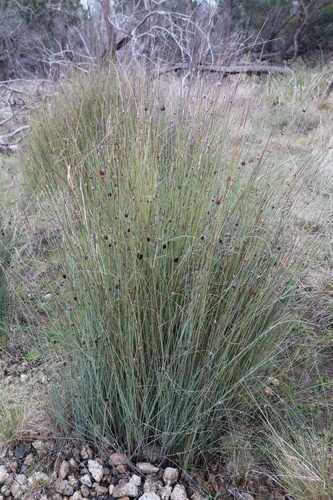
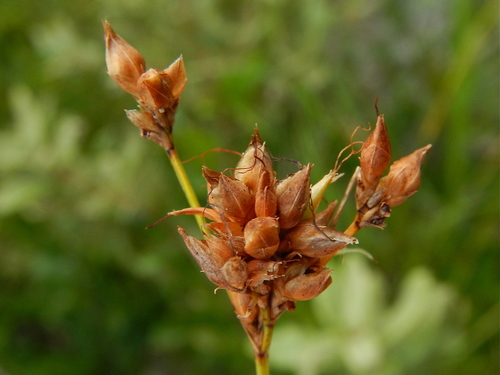
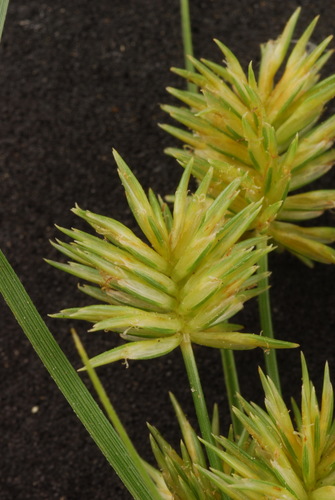
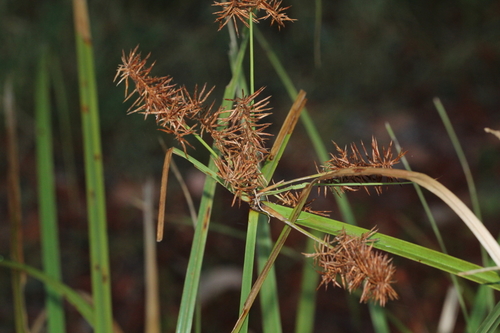
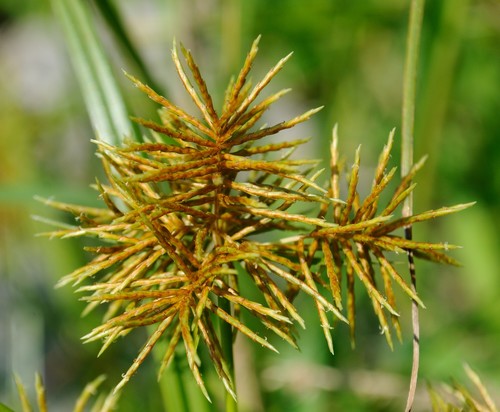
Cyperus odoratus sensu lato is an annual sedge that averages close to half a meter in height, though it is known to grow much taller. It typically bears several long, thin leaves around its base. Its inflorescence consists of one to several cylindrical spikes, each shaped like a bottle brush. Five to eight leaf-like bracts grow at the base of the inflorescence. Each spike holds a large number of flat, oval-shaped spikelets. Most spikelets are light brown to reddish-brown, and contain anywhere from a few to over 20 flowers. Each flower is covered by a tough, flat scale, a type of bract, with a clearly visible midvein. Its fruit is a flat achene shorter than two millimeters.
Cyperus odoratus sensu stricto is similar to Cyperus engelmannii. The floral scales of Cyperus odoratus overlap. By contrast, the mature floral scales of Cyperus engelmannii do not overlap: the tip of each scale does not reach the base of the next scale on the same side of the spikelet. The mature achenes of Cyperus odoratus are slightly ellipsoid, while the achenes of Cyperus engelmannii are narrow with parallel, linear edges. Fully developed achenes of Cyperus odoratus are 0.5–0.7 mm wide, while those of Cyperus engelmannii are 0.3–0.4 mm wide. Cyperus odoratus and Cyperus engelmannii are the only two Cyperus species in temperate North America whose spikelets eventually break apart into one-seeded segments. At maturity, each spikelet breaks into segments, each consisting of a scale and an achene held together by a section of the floral axis.
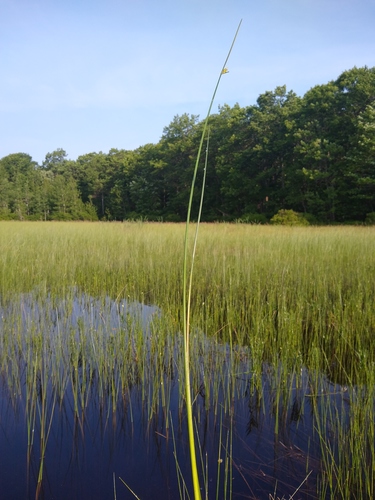
Cyperus odoratus sensu lato occurs across much of the tropical and warm temperate world, including South America, Central America, North America, Southeast Asia, some Pacific Islands, Australia, New Guinea, Madagascar, and central Africa. It grows in wet, muddy areas, including disturbed and altered sites. The subspecies Cyperus odoratus subsp. transcaucasicus is native to Iran, Iraq, and the South Caucasus.