About Cyperus houghtonii Torr.
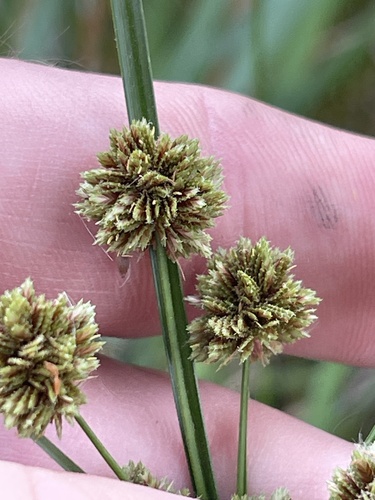
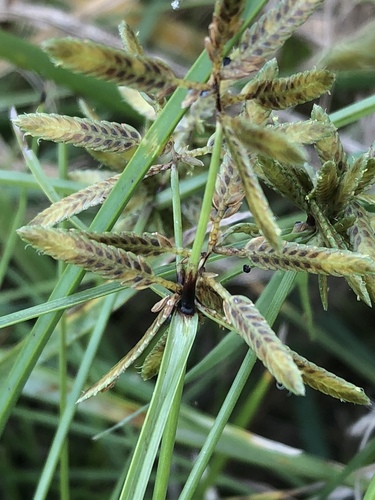
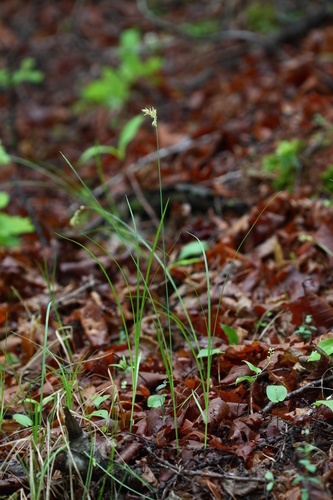
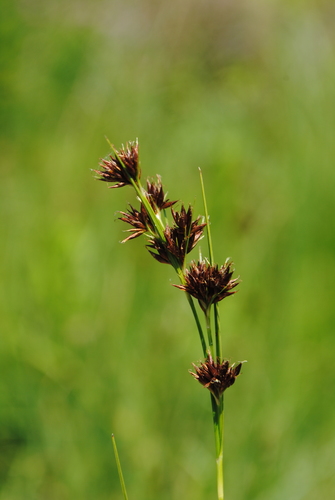
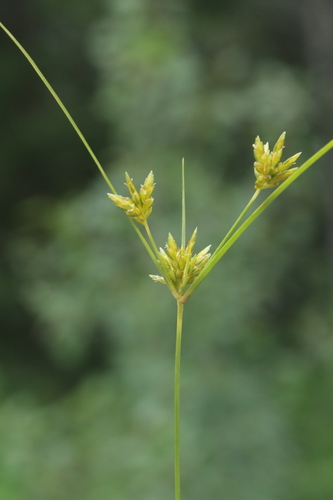
Cyperus houghtonii Torr. is thought to have originated from a backcross hybrid between Cyperus lupulinus ssp. macilentus and Cyperus schweinitzii. Researchers have theorized that the glaciated habitats where Cyperus houghtonii is commonly found formed a new niche that neither of its parent species were well adapted to, while Cyperus houghtonii is more suited to this habitat. This species grows 4 to 20 inches tall. It produces 1 to 5 flower clusters at the tip of its stem, each measuring up to 3/4 of an inch across. Each flower cluster holds 3 to 18 spikelets. At the base of the flower clusters are 3 to 8 erect to ascending bracts, which measure 1 to 8 inches long. The spikelets are flattened and oblong, and reach 1.5 cm in length. Each floret has three stamens and a three-parted style. Cyperus houghtonii occurs in a range of dry, sandy habitats, including ledges, roadsides, lakeshores, sandplains, woodlands, shale barrens, and rock outcrops. In Minnesota, it is often found in or near jack pine stands. Its documented distribution includes Manitoba, Ontario, Quebec, Minnesota, Michigan, Indiana, Wisconsin, Vermont, New Hampshire, Massachusetts, Pennsylvania, Maryland, Virginia, and North Carolina. It is considered historic in Maine and Ohio, and it is regarded as rare across its entire range.