About Cyperus esculentus L.
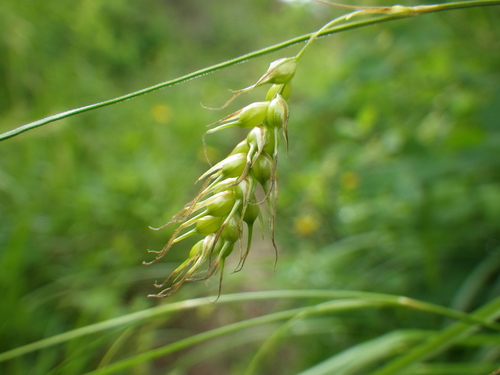
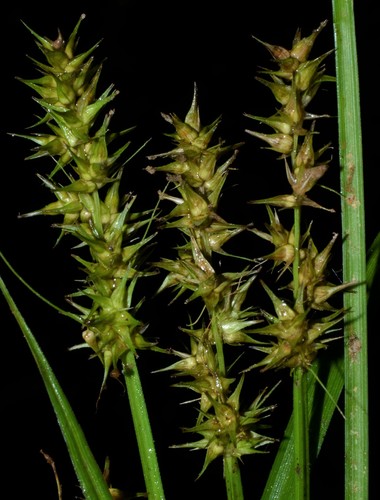
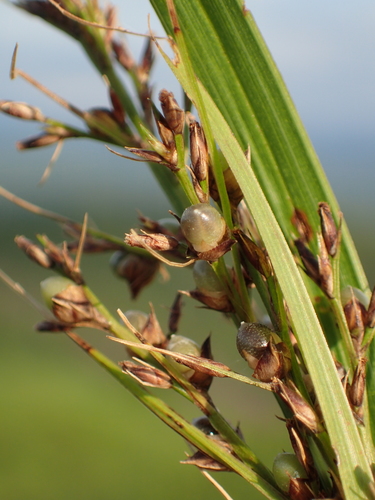
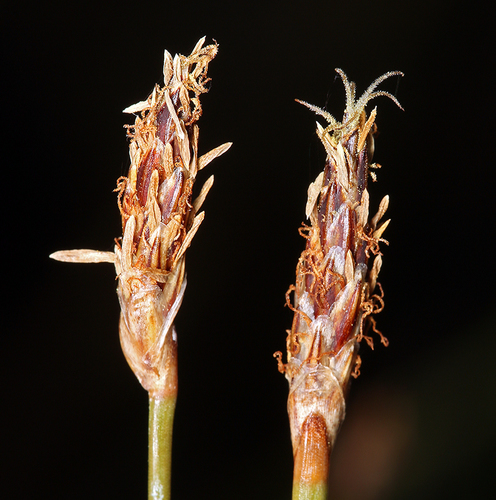
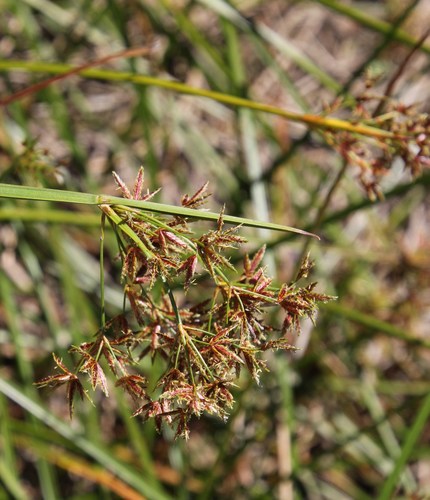
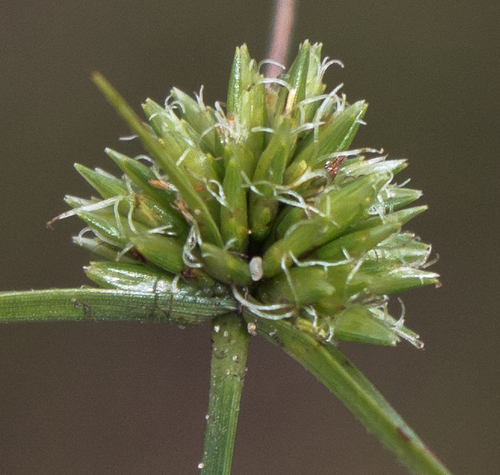
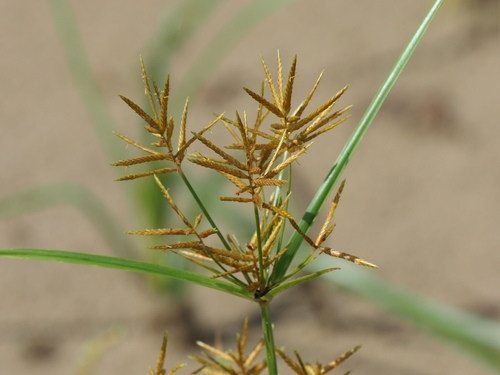
Cyperus esculentus L. is an annual or perennial plant that grows up to 90 centimetres (3 feet) tall, with solitary stems growing from a tuber. It reproduces via seeds, creeping rhizomes, and tubers. Because of its clonal growth habit, it can easily colonize areas after soil disturbances caused by human activity or natural forces. Its stems are triangular in cross-section and bear slender leaves that are 3–10 millimetres (1⁄8–3⁄8 inch) wide. The plant's spikelets are distinctive: they form a cluster of flat, oval seeds surrounded by four hanging, leaf-like bracts arranged 90 degrees apart from each other. Spikelets are 5 to 30 mm (1⁄4 to 1+1⁄8 in) long, linear to narrowly elliptic with pointed tips, and hold 8 to 35 florets, with color ranging from straw-colored to gold-brown. A single plant can produce up to 2420 seeds. Its foliage is very tough and fibrous, and is often mistaken for grass. It has an extensive, complex root system made of fine fibrous roots and scaly rhizomes, with small, hard, spherical tubers and basal bulbs attached. The tubers measure 0.3–2.5 cm (1⁄8–1 in) in diameter and range in color from yellow to brown to black. One plant can produce several hundred to several thousand tubers in a single growing season. When temperatures cool, the foliage, roots, rhizomes, and basal bulbs die, but tubers survive and resprout the following spring once soil temperatures stay above 6 °C (43 °F). Tubers can even resprout up to several years after being produced. When tubers germinate, they produce multiple rhizomes that end in a basal bulb near the soil surface. These basal bulbs then produce above-ground stems and leaves, and underground fibrous roots. Cyperus esculentus is wind-pollinated and requires cross-pollination, as it is self-incompatible. Ecologically, Cyperus esculentus is a highly invasive species in Oceania, Mexico, some regions of the United States (where it is also native), and the Caribbean, spreading primarily through seed dispersion. It is easily transported internationally, and can adapt to re-establish itself in a wide range of climate and soil environments. In Japan, it is an exotic clonal weed that readily establishes in wet habitats. In North America, it serves as a larval host for Euphyes vestris (dun skipper) and Diploschizia impigritella (yellow nut-sedge moth). It is likely that Cyperus esculentus reached the New World via ocean currents before the Holocene epoch. Cyperus esculentus is cultivated in Egypt, Spain, Nigeria, the United States, Guatemala, Mexico, Chile, Brazil, Lebanon, Syria, Jordan, Saudi Arabia, Oman, Iran, Iraq, Pakistan, India, Yemen, Morocco, Ivory Coast, Sudan, South Sudan, Gambia, Guinea Bissau, Ghana, Niger, Burkina Faso, Togo, Benin, Cameroon, and Mali. In most of these cultivation regions, it is used primarily as animal feed or a side dish; in Hispanic countries, it is mainly used to make horchata, a sweet, milk-like beverage. For cultivation, Cyperus esculentus is normally planted in previously tilled, flat soils with ridges to ease irrigation. Seeds are planted manually on these ridges, which are approximately 60 cm (2 ft) apart. The spacing between individual seeds ranges from 15 to 20 cm (6 to 8 in), and seeding depth is around 8 cm (3 in). A typical seeding rate for chufa (the cultivated form of Cyperus esculentus) is about 120 kg of tubers per hectare (107 lbs per acre). Planting occurs between April and May, and crops must be irrigated every week until harvest in November and December. Tubers develop about 6–8 weeks after seedling emergence, and grow quickly during July and August. Maturation takes 90–110 days, and average yields range between 10 and 19 tonnes per hectare. Dried tiger nut (the common name for Cyperus esculentus tubers) has a smooth, tender, sweet, nutty taste. It can be consumed raw, roasted, dried, baked, or processed into tiger nut milk, tiger nut drink, or oil. The tubers are edible raw or cooked, with a slightly sweet, nutty flavor that differs from the more bitter tubers of the related species Cyperus rotundus (purple nutsedge). The raw tubers are quite hard, so they are generally soaked in water before eating to soften them and improve their texture. They are a popular snack in West Africa. Tubers can also be dried and ground into flour. In Northern Nigeria, the plant is called aya, and its tubers are usually eaten fresh. They are sometimes dried, then rehydrated before eating. A sugar-coated toasted tuber snack is popular with Hausa children in Northern Nigeria. A drink called kunun aya is also made by processing tubers with dates, then straining the mixture and serving it chilled. In Egypt, tiger nuts are called ḥab el ʿAzīz; after being softened by soaking in water, they are sold from hand carts as street food, and their popularity has even been featured in media, including a song named after the product. Flour made from roasted tiger nut is sometimes added to biscuits and other bakery products. It is also used in making oil, soap, and starch extracts, as well as in the production of nougat, jam, beer, as a flavoring agent in ice cream, and in making kunu, a local Nigerian beverage. Kunu is a nonalcoholic beverage traditionally made primarily from cereals such as millet or sorghum, prepared by heating and mixing with spices including dandelion, alligator pepper, ginger, and licorice, plus sugar. Tiger nut is a good substitute for cereal grains in kunu, improving the low nutritional value of the traditional cereal-only version. Tiger nut oil can be used raw for salads or for deep frying, and is considered a high-quality oil. Tiger nut "milk" has been tested as an alternative milk source for fermented products such as yogurt, and other fermented products common in some African countries, so it can be used to replace milk in the diets of people with some degree of lactose intolerance.