About Cyperus eragrostis Lam.
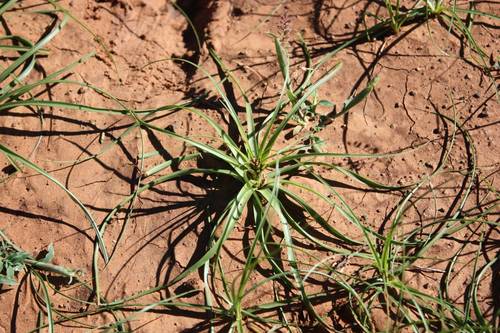
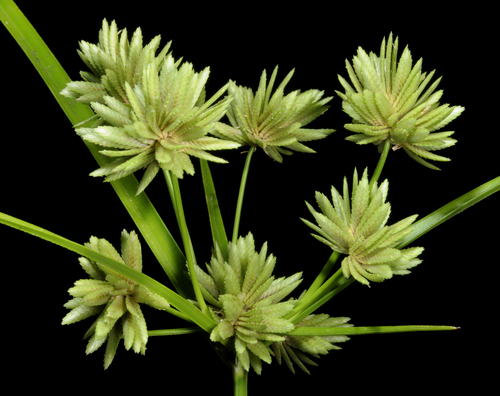
Cyperus eragrostis is a tufted herbaceous plant in the sedge family, and it is commonly mistaken for a grass. It can be distinguished from grasses by many key features. It has a short, thick, woody rhizome that helps it survive seasonal changes. Its stems are trigonous, solid, leafy, slightly thicker at the base, and grow between 25 and 90 cm tall. Leaves grow from the base of the plant; they are slender, flat, linear, with finely serrated margins. They are usually flat, but may sometimes be slightly folded into a shallow V-shape, which helps them blend in with various grass species. Leaves are 4 to 8 mm wide, typically bright green, and their protective sheaths are dark purple-brown. The inflorescence is one of this species’ most defining features, and it gives the plant one of its common names: umbrella sedge. A compound umbel grows at the top of the stem, made up of up to twelve rays that are 3 to 10 cm long, each ending in a globose head. These rounded heads are 10 to 20 mm in diameter, and are not single flowers – they are clusters of small spikelets, each holding 20 to 40 smaller flowers. The globose heads are surrounded by 5 to 8 much longer protective leaves. The spikelets on each head are narrow, yellow, green or brown, and 10 to 15 mm long. Each spikelet can produce up to 40 bisexual florets, which are wrapped in a glume. Each flower contains one stamen and three stigma styles that are 1 to 1.2 mm long. After fertilization, Cyperus eragrostis produces a dry, hard-shelled, trigonous achene fruit, which is dark brown to black and 1.2 to 1.3 mm long. With all these distinct features, Cyperus eragrostis is easy to identify, especially during flowering season when it stands out from the grasses it is often confused with. Cyperus eragrostis is native to the subtropical and tropical regions of South America, including Argentina, Bolivia, Brazil, Chile, and Peru. It has been introduced to parts of Canada, Mexico, and areas of the United States including California, Mississippi, Louisiana, New Jersey, South Carolina, Texas, Oregon, Pennsylvania, and Washington. Outside its native range, it has spread to many regions worldwide through introduction and naturalization. It is recorded as an invasive species in many European countries: France, Switzerland, Germany, Spain, Hungary, the Netherlands, Portugal, England, Italy, Montenegro, the Czech Republic, Slovenia, Bulgaria, and Turkey. It is also found scattered across both the North and South Islands of New Zealand, where it is listed as an invasive pest weed. This species grows in a variety of habitats around the world. It thrives in wet, open, disturbed areas with hydric (saturated) soils, including wetlands, ditches, roadside ditches, riverbanks, ponds, swamps, floodplains, mud flats, shallow vegetated channels in pastures and fields, sandflats, and muddy lake edges. It is heliophilous, meaning it grows best in areas with full sun and little shade. It is sensitive to salinity, and prefers moderate to high nutrient-rich soils with a neutral pH. It can successfully establish in both clay-loam and sandy-loam soils, which makes it easy for the species to spread and reproduce. It acquires nutrients through its roots, so it prefers mesotrophic (balanced nutrient) soil with high organic matter content. For these reasons, Cyperus eragrostis can easily establish itself across the globe in both natural and human-modified environments. Cyperus eragrostis establishes populations quickly because it reproduces in two ways: sexually via seeds, and vegetatively via spreading rhizomes. Vegetative growth begins in spring, either from germinating seeds or resprouting from existing rhizomes. In the right conditions, flowers and small hard achene fruits develop on the compound umbels of spikelets from late spring through summer. Fruiting finishes by late summer, and mature seeds wait to be dispersed. The seeds have a very high germination rate, which allowed the species to spread rapidly after it was introduced to many countries for decorative and recreational uses. It also reproduces in large numbers via its rhizomes, which helps it grow dense populations in moist disturbed environments. In some regions, people eat the small nut-like tubers of Cyperus eragrostis raw or cooked. This is not a common practice, as the species is considered an invasive weed in most of the regions where it grows today, but cooked tubers are described as tasting like coconuts and raisins. The rhizome (stem base) is also edible. Native Americans used the leaves of Cyperus eragrostis to weave baskets and other items. One reason that may have led to this species’ intentional introduction is its ability to control erosion. Its rhizomes allow it to form dense clumps in soil that help stabilize and restore degraded areas. However, once introduced, Cyperus eragrostis readily overtakes native plant communities and outcompetes native species.