About Cyornis pallidipes (Jerdon, 1840)
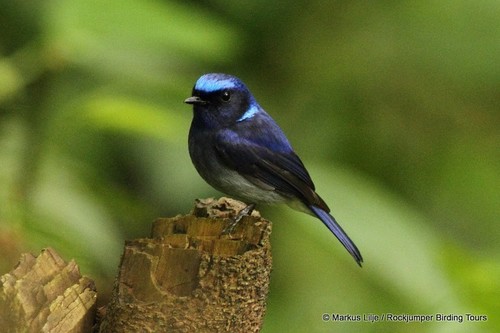
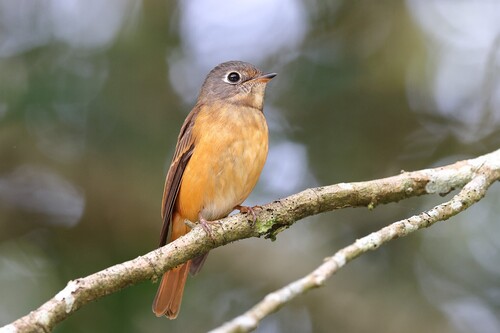
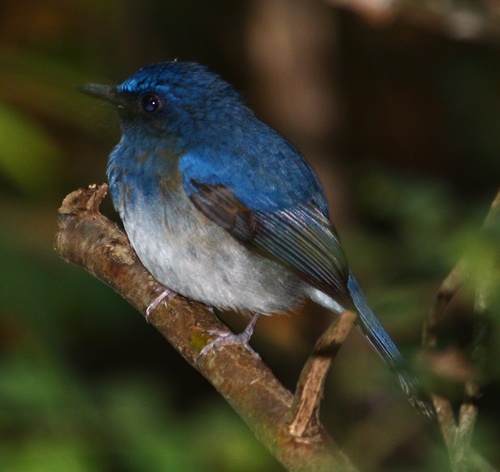
The white-bellied blue flycatcher, scientifically named Cyornis pallidipes (Jerdon, 1840), reaches approximately 13 centimetres (5.1 in) in length and has a moderately long beak. It forages in undergrowth located in the shade of dense forest canopies, making short aerial attacks to catch insects. Males are indigo blue, with ultramarine blue supercilia and foreheads. Their lores and face are dark grey, and their bellies are white, edged with a smoky grey wash. Females are olive brown on their upper bodies, with whitish lores. Their rufous throat and breast fade to white toward the belly, and they have a chestnut tail. Females can be distinguished from many other similar flycatchers by their lack of a black and white tail pattern. In poor lighting within the Palni Hills, this species can be confused with the white-bellied blue robin; however, the white-bellied blue robin has longer legs and is more often seen on the ground. This flycatcher occurs in dense forest and sholas, ranging south from Mahabaleshwar through the Western Ghats. Its distribution extends into the Nilgiris and the Biligirirangan Hills, and continues down to southern Tamil Nadu and Kerala. It is found mainly in hill forests, from the foothills up to around 1700 m in the Nilgiris. The white-bellied blue flycatcher is typically quiet and inactive, and forages primarily in dark shade under the forest canopy. It has a very soft, low song that can only be heard when the listener is at close range. The song is a wandering sequence of broken rising and falling notes, mixed with clicks and squeaks. These flycatchers are usually seen alone or in pairs, and often join mixed-species foraging flocks. Their breeding season runs from February to September, and occurs mainly during the monsoon. Their nest is a rough cup-shaped structure made of moss, neatly lined on the inside, and placed low down on a moss-covered rock, in a tree hole, or on a mud bank. The usual clutch size is four eggs, which are pale sea-green with brown spotting that is denser toward the broad end of the egg.