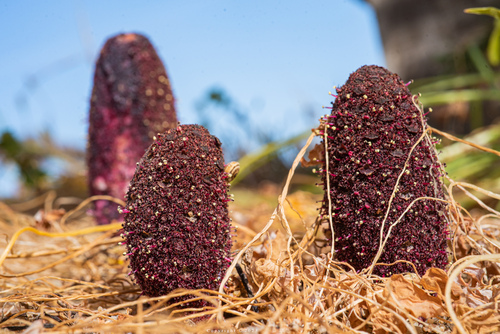
About Cynomorium coccineum L.
Cynomorium coccineum L. is a non-photosynthetic plant that contains no chlorophyll. It is a geophytic holoparasite that is completely dependent on its host, spending most of its life underground as a rhizome attached to the roots of a host plant. A low-growing inflorescence emerges in spring, after winter rain, from a fleshy, unbranched stem, most of which remains underground. The stem bears scale-like, membranous leaves. The inflorescence is dark-red or purplish, forming a dense, erect, club-shaped mass 15–30 cm (5.9–11.8 in) long, made up of many tiny scarlet flowers that may be male, female, or hermaphrodite. This plant is pollinated by flies, which are attracted by its sweet odour that has a slight cabbage-like scent. After pollination, the inflorescence spike turns black. The plant produces a small, indehiscent nut as its fruit. In the Mediterranean region, Cynomorium parasitizes salt-tolerant plants from the families Cistaceae (cistus family) or Amaranthaceae (amaranth family); in other regions, it parasitizes plants from Amaranthaceae and Tamaricaceae (tamarisk family). In China, it most often parasitizes Nitraria sibirica, a member of Nitrariaceae. Some sources note that its primary hosts are saltbushes (Atriplex species, family Amaranthaceae). Previous classification placed Cynomorium in the family Balanophoraceae, but DNA studies suggest it is more likely a member of the order Saxifragales, possibly closely related to Crassulaceae (stonecrop family). This classification question is complicated by widespread horizontal gene transfer between Cynomorium and its various different hosts. Two varieties are formally recognized. Cynomorium coccineum var. coccineum occurs from the Atlantic coastal desert of Mauritania and Western Sahara, through Morocco, the Canary Islands, southern Iberia (Portugal and Spain), the Balearic Islands, Algeria, Corsica, Sardinia, Sicily, southern Italy, Malta, Tunisia, Libya, Egypt, the Arabian Peninsula, Somalia, Iran, and Afghanistan. Cynomorium coccineum var. songaricum grows at high altitudes in Central Asia and Mongolia. Many authorities consider this variety to be a separate species, C. songaricum. In China, it is called "suoyang" (Chinese: 鎖陽) and is widely collected for use as a herbal remedy for conditions including sexual concerns and nocturnal emissions. Following the logic of the Doctrine of Signatures, Sir David Attenborough notes that the phallic shape of Cynomorium's inflorescence led early herbalists to conclude it could cure erectile dysfunction and other sexual problems. Additionally, its dark red colour led to the belief that it could treat anaemia and other blood-related diseases. Similar traditional uses are recorded across both the eastern and western parts of the plant's range. Crusaders carried dried inflorescence spikes to help them heal from wounds. Other traditional uses include treatment for apoplexy, dysentery, sexually transmitted diseases, hypertension, vomiting, and irregular menstruation. The city of Kuyu 苦峪 is also known as Suoyang City, named after the Chinese name for this plant, according to a legend that 7th-century general Xue Rengui and his army survived a siege there by eating Cynomorium. During the Yuan dynasty, the plant was introduced or imported to China from Mongolia as a medicinal plant. It was first documented in 1347 by Zhū Dānxī (朱丹溪) in his work Supplement and Expansion of Materia Medica (Chinese: 本草衍義補遺; pinyin: Běncǎo Yǎnyì Bǔyí). Zhū Dānxī included it as an ingredient in his hidden tiger pills (Chinese: 虎潛丸 or 虎潜丸; pinyin: hǔqián wán), a remedy for impotence and weak legs. In the 16th century, the Knights of Malta valued the plant highly and sent samples to European royalty. They incorrectly classified it as a fungus, leading to the common names "fungus melitensis" and "Maltese mushroom". The Knights guarded Fungus Rock, a large coastal rock formation just off the coast of Gozo, where the plant grew abundantly on the flat top. They smoothed the rock's sides to prevent theft of the plants, and theft was reportedly punishable by death. The only access to the top was via a precarious cable car, which was maintained into the early 19th century. Today, the rock is a nature reserve, so access remains strictly limited. In the Middle Ages, Arabic physicians named this plant "tarthuth" and referred to it as "the treasure of drugs". A 9th-century medical formulary (aqrabadhin) compiled by Al-Kindi lists tarthuth as an ingredient in a salve to soothe skin irritation; later, Rhazes (Al-Razi) recommended it to treat piles, nosebleeds, and dysfunctional uterine bleeding. In Saudi Arabia, an infusion made from ground, dried mature inflorescence spikes is used to treat colic and stomach ulcers. Bedouin people ate fresh Cynomorium spikes on long journeys: they cleaned and peeled the fresh spikes to eat the crisp white interior, which is described as succulent and sweet, with an apple-like flavour and a mild pleasant astringency. Camels also readily eat this plant. It has frequently been used as a famine food, with the last recorded use occurring in the 19th century in the Canary Islands. Other documented uses include use as a contraceptive, as toothpaste, and as a source of non-fading crimson fabric dye.

