About Cynanchum L.
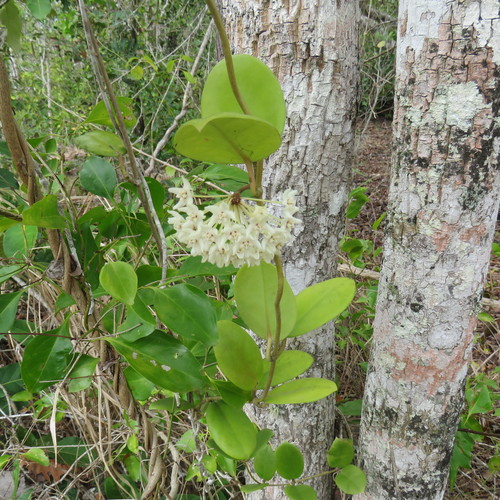
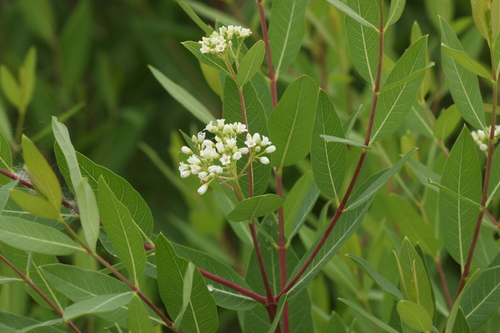
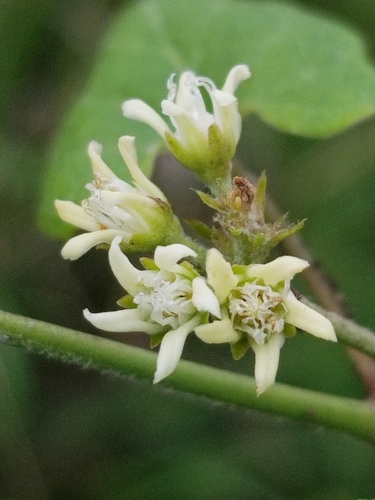
Cynanchum laeve is a twining vine with heart-shaped leaves, and it commonly grows along roadsides, fence rows, fields, and disturbed areas. This species can be easily identified as a member of the Apocynaceae family by its opposite leaves, milky sap, and distinctive flowers and follicles, which are called "milkweed pods". Its seeds are dispersed by wind and can travel long distances. Each individual plant can produce up to 50 follicles. It has a fleshy, brittle root system made up of a large taproot plus additional lateral roots, and these roots can grow as deep as 6 feet. Young developing stems are light pink, and release milky sap when broken. Its flowers are vase-shaped, with 5 white petals, and grow in clusters on short stalks. C. laeve flowers between June and September. C. laeve is distributed across the eastern and central United States and Ontario, Canada. It can be found in wetland areas within the arid West, Atlantic and Gulf Coastal Plain, Eastern mountain and Piedmont, the Great Plains, Midwest, and the North Central and North Eastern United States. It typically grows in disturbed habitats including thickets, low moist fields, riverbanks, fence rows, and cultivated fields. C. laeve is a food source for monarch butterfly caterpillars. Larvae of the milkweed tussock moth Euchaetes egle, found in both the Eastern and Western United States, also feed on C. laeve as they develop, alongside other plant species. C. laeve is not edible for humans. Its sap can cause eye irritation and damage mucous membranes. If consumed in large quantities, it is toxic to humans. Thorough hand washing is recommended after handling the plant. Hay fed to livestock can become contaminated with C. laeve, which is toxic to livestock when eaten in large amounts. Most animals avoid eating C. laeve because of its bitter taste. The US Fish and Wildlife Service recommends taking precautionary steps to manage risk: do not graze hungry animals in pastures that contain C. laeve, eradicate the plant from driveways and trails, and closely monitor livestock that have just been moved into areas where C. laeve grows. Because C. laeve has a deep, extensive root system, it is very difficult to eradicate from agricultural fields. As a climbing vine that grows over other plants, it can create problems during crop harvesting.