About Cynanchum ellipticum (Harv.) R.A.Dyer
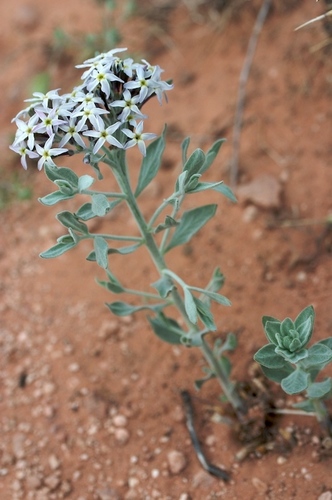
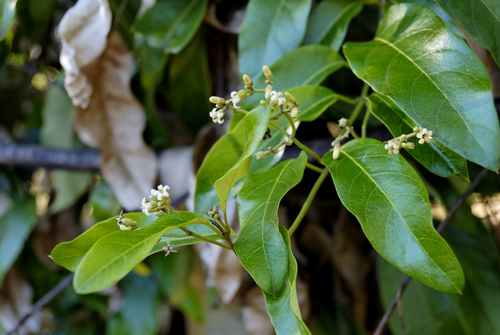
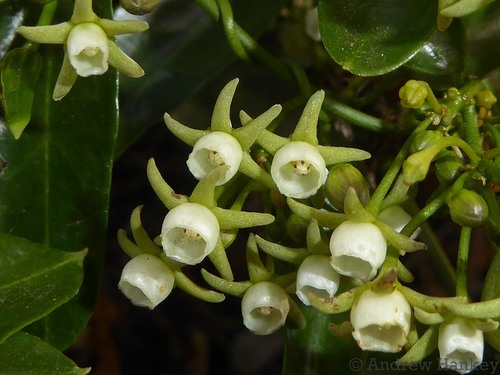
Cynanchum ellipticum (Harv.) R.A.Dyer is a South African climbing plant that belongs to the Apocynaceae family. This sprawling twiner has slender stems and branches that exude milky, bitter, non-irritant latex. It grows in coastal scrub from Cape Town north to Mozambique, extending inland up to 1300 m; it can be found on flats or moderate slopes, in sand or between rocks, in indigenous forests, along forest margins, and in thickets, and it frequently grows in disturbed habitats. Its opposite semi-succulent leaves are 20–40 mm long and 10–20 mm wide, shaped elliptic to oblong or broadly elliptic with a prominent apiculate tip, and have a ring-like thickening at the point where petioles connect to the stem. Tiny sweetly scented white or cream flowers grow in helicoid cymes from leaf axils, and feature a tubular corolla. Its horn-shaped fruits (follicles) hold club-shaped plumed seeds. Members of the order Apocynales are well known for containing cardiac glycoside metabolites in their roots, stems, leaves, and seeds; this species produces pregnane glycosides, also called cynanchosides. When livestock ingest its leaves, it can cause a condition called Cynanchosis, also known as 'Krampsiekte'. This condition is not the same as 'Krimpsiekte', which is caused by plant species from the genera Cotyledon and Tylecodon. In horses, Cynanchosis begins with abnormal behavior and aggression, progresses to limb pain and lameness, and ultimately results in an inability to stand. Due to this toxicity, C. ellipticum is considered a troublesome weed in some areas. The genus Cynanchum is distributed worldwide, and contains around 200 species. The main center of diversity for this genus in Africa is Madagascar, which hosts approximately 70 species. The current accepted name of this species was published by R. A. Dyer in 1937, in The vegetation of the Divisions Albany and Bathurst, Memoirs of the Botanical Survey of South Africa 17: 138.