About Cymbidium madidum Lindl.
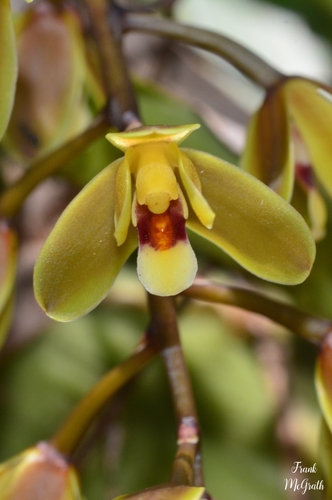
Cymbidium madidum (common name giant boat-lip orchid) is a clump-forming epiphytic or lithophytic herb. It produces crowded, oval, slightly flattened green pseudobulbs that measure 120–250 mm (4.7–9.8 in) long and 40–60 mm (1.6–2.4 in) wide. Each pseudobulb grows four to eight thin, strap-like, flexible leaves, which are 300–900 mm (12–35 in) long and 30–40 mm (1–2 in) wide. An arching flowering stem 200–600 mm (7.9–24 in) long bears between ten and seventy flowers. Individual flowers are olive green to brownish green, 22–35 mm (0.87–1.4 in) long and 20–30 mm (0.79–1.2 in) wide. The sepals and petals curve forward instead of spreading widely: sepals measure 12–15 mm (0.47–0.59 in) long and 5–6 mm (0.20–0.24 in) wide, while petals measure 10–13 mm (0.39–0.51 in) long and 4–5 mm (0.16–0.20 in) wide. The labellum is three-lobed, 12–15 mm (0.47–0.59 in) long and 5–6 mm (0.20–0.24 in) wide. The side lobes of the labellum are erect, and the yellowish middle lobe has a shiny ridge along its midline. Flowering takes place between August and February. This orchid grows in rainforest and other moist habitats, growing on trees with fibrous or papery bark, and on rocks and cliffs. It is distributed from Cape York Peninsula in Queensland, south to the Hastings River in New South Wales. Aboriginal Australians and early European settlers used the pseudobulbs of this orchid to treat dysentery, and used its seeds as an oral contraceptive.