About Cylindropuntia prolifera (Engelm.) F.M.Knuth
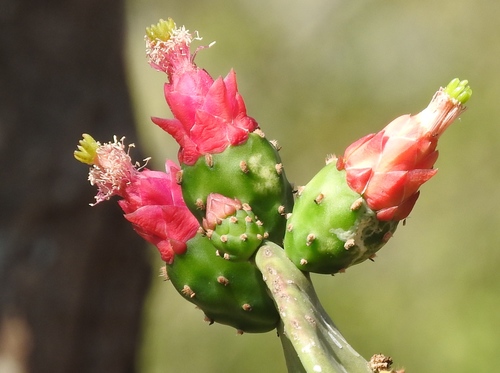
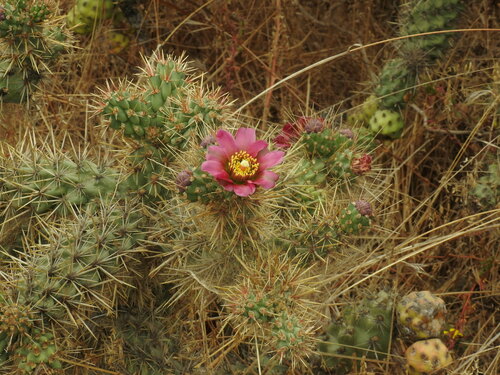
Cylindropuntia prolifera is a mostly erect, treelike cactus that can reach a maximum height close to 3 meters. Its gray-green segments are narrow and cylindrical, covered with fleshy tubercles that hold many brown or reddish spines up to 2 centimeters long. Its flowers are reddish purple, and often grow on the fruits from previous seasons. Fruits develop in chains that can contain up to 5 individual fruits, and are green in color. This cactus is native to Southern California and Baja California, where it grows in coastal sage scrub, chaparral, beach, and bluff habitats. Its native range extends south from Santa Barbara County. In parts of Australia, Cylindropuntia prolifera serves as an example of an invasive species. It was introduced there as a low-maintenance plant that does not require watering. Introduced populations of this cactus do not appear to flower as abundantly as documented in botanical literature, but they spread effectively when stem segments break off. Segments can travel on the fur and feet of animals, sometimes crippling or killing the animals that carry them, or on car tires. After a segment is dropped, it can survive for many months until rain triggers rooting. Chemical control of this invasive cactus requires large amounts of resources, and this process is not only resource-intensive but also dangerous when the plants grow in steep mountainous areas. Trials are currently testing cochineal beetles for control of various genera in the Opuntia group. For Cylindropuntia prolifera, cochineal beetles kill infected plants, but do not spread well on their own. When new outbreaks of the cactus are discovered, chunks of beetle-infected plant material are manually moved to the new site to introduce the biocontrol agent.