About Cygnus olor (J.F.Gmelin, 1789)
This species is mute swan, with the scientific name Cygnus olor (J.F.Gmelin, 1789).
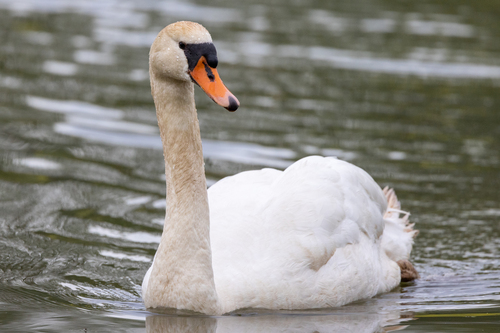
Description Adult mute swans are large waterfowl. They typically measure 140 to 160 cm (55 to 63 in) in length, with extreme measurements ranging from 125 to 170 cm (49 to 67 in), and a wingspan of 200 to 240 cm (79 to 94 in). Males are larger than females, and also have a larger knob on the bill. On average, mute swan is the second largest waterfowl species, after the trumpeter swan; however, male mute swans can easily match or even exceed the mass of a male trumpeter swan. Standard measurements for the species are as follows: the wing chord measures 53–62.3 cm (20.9–24.5 in), the tarsus measures 10–11.8 cm (3.9–4.6 in), and the bill measures 6.9–9 cm (2.7–3.5 in). Mute swans have white plumage, dark grey legs, and a bright orange beak with black markings around the nostrils and a black nail.
Mute swan is one of the heaviest extant flying birds. Multiple studies conducted in Great Britain found that males (called cobs) have an average weight of roughly 10.6 to 11.87 kg (23.4 to 26.2 lb), with a total weight range of 9.2–14.3 kg (20–32 lb). Slightly smaller females (called pens) have an average weight of roughly 8.5 to 9.67 kg (18.7 to 21.3 lb), with a total weight range of 7.6–10.6 kg (17–23 lb). The normal top weight for a large cob is roughly 15 kg (33 lb), but one unusually large Polish cob weighed almost 23 kg (51 lb). This is the largest verified weight ever recorded for a flying bird, though it remains questioned whether this very heavy individual was still capable of flight.
In flight, mute swans can reach speeds of up to 88.5 km/h (55 mph). During takeoff, they reach running speeds of around 48 km/h (30 mph) to gain lift.
Young mute swans are called cygnets. They do not have the bright white plumage of mature adults, and their bill is dull greyish-black rather than orange for their first year. Their natal down can range from pure white to grey to buff, with grey/buff being the most common morph. White cygnets carry a leucistic gene. Cygnets grow quickly, reaching a size close to adult size approximately three months after hatching. Cygnets typically keep their grey feathers until they are at least one year old, and the down on their wings is replaced by flight feathers earlier in that first year. All mute swans are white when they reach maturity, though feathers (particularly on the head and neck) are often stained orange-brown by iron and tannins found in water.
Distribution and habitat The natural range of the mute swan is mainly in temperate areas of Europe and across the Palearctic, extending as far east as Primorsky Krai near Sidemi. It is partially migratory across northern latitudes in Europe and Asia, migrating as far south as North Africa and the Mediterranean. It has been recorded nesting in Iceland, and is a vagrant in Iceland as well as Bermuda. According to a UN Environment Programme chart of the international status of bird species, the species occurs in 70 countries, breeds in 49 countries, and is a vagrant in 16 countries. Most of the current mute swan population in Japan is introduced. However, mute swans are depicted on scrolls more than 1,000 years old in Japan, and wild birds from mainland Asian populations still rarely occur there in winter. Natural migrants to Japan usually occur alongside whooper swans, and sometimes Bewick's swans.
Mute swan is protected across most of its range, but this protection has not stopped illegal hunting and poaching. It is often kept in captivity outside its natural range as an ornamental bird for parks and ponds, and captive birds have occasionally escaped. Descendants of these escaped birds have become naturalized in the Eastern United States and Great Lakes, similarly to how Canada geese have become naturalized in Europe.