About Cygnus melancoryphus (Molina, 1782)
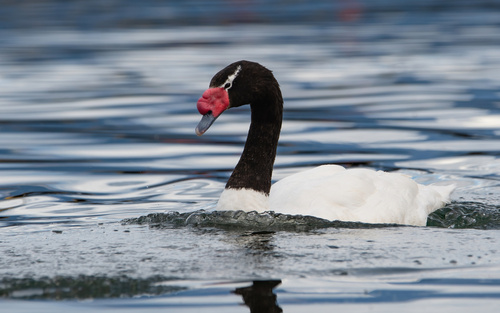
The black-necked swan (Cygnus melancoryphus (Molina, 1782)) is the only member of its genus that breeds in the Neotropics, and it is the largest waterfowl native to South America. Adult black-necked swans measure 102 to 124 cm (40 to 49 in) in total length, with a wingspan ranging from 135 to 177 cm (53 to 70 in). Males weigh between 4.6 to 8.7 kg (10 to 19 lb), while females weigh between 3.5 to 4.4 kg (7.7 to 9.7 lb). The two sexes look identical. Adult plumage has a white body, with black neck and head. A white stripe usually runs behind the eye on the black head. The species has a prominent red knob at the base of its bill. Juveniles have grayish body plumage instead of white, and they do not develop the red knob until their third or fourth year of life. This swan species is found across the southern tier of South America. Its breeding range extends from Tierra del Fuego north to central Chile, Uruguay, and Rio Grande do Sul in extreme southern Brazil. In winter, it leaves the southern half of Argentina and can be found as far north as São Paulo state, Brazil. It is a year-round resident on the Falkland Islands. Vagrants of this species have been recorded on Juan Fernández Island, the South Orkney Islands, the South Shetland Islands, and the Antarctic Peninsula. Black-necked swans inhabit freshwater marshes and swamps, shallow lakes, brackish lagoons, and sheltered coastal sites. On the South American mainland, it is often found near human habitation, but it avoids built-up areas in the Falklands. It generally occurs at low elevations, but non-breeding flocks can be found at elevations as high as 900 to 1,250 metres (3,000 to 4,100 ft) in the Andes of southern Argentina. Wetlands formed in Chile by the 1960 Valdivia earthquake, including the Carlos Anwandter Nature Sanctuary on the Cruces River, have become important population centers for the black-necked swan. The species' population in this sanctuary has fluctuated dramatically over the years. It hit a low of 214 individuals in January 2008, reached a peak of 22,419 in May 2020, and dropped to 2,782 individuals by May 2022.