About Cygnus columbianus (Ord, 1815)
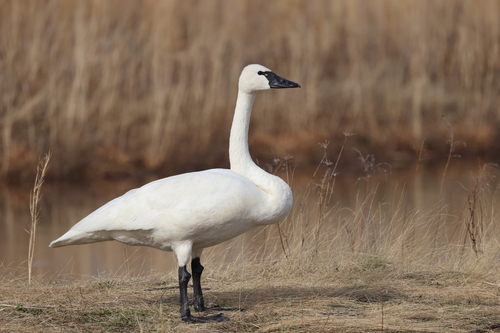
Cygnus columbianus, commonly called the tundra swan, is the smallest swan species found across the Holarctic. Adults measure 115–150 cm in total length, have a 168–211 cm wingspan, and weigh between 3.4–9.6 kg. Females (called pens) are slightly smaller than males (called cobs), but do not differ in appearance otherwise. The plumage of adult birds of both subspecies is entirely white, with black feet. The bill is mostly black, with a thin salmon-pink streak along the mouthline, and variable amounts of yellow on the proximal (base) portion depending on the subspecies. Adult irises are dark brown. When individuals live in waters with high concentrations of iron ions, such as bog lakes, their head and neck plumage takes on a golden or rusty discoloration. Immature swans of both subspecies have white plumage mixed with dull grey feathering, concentrated mostly on the head and upper neck, which are often entirely light grey. Immatures gain mostly white plumage by their first summer, and molt into full adult plumage by their second winter. Juvenile bills are black with a large dirty-pink patch covering most of the proximal half, often with black nostrils, and juvenile feet are dark grey with a pinkish tint. Downy young have silvery grey plumage on their upperparts and white plumage on their underparts. There are two recognized subspecies of Cygnus columbianus: Bewick's swan (Cygnus columbianus bewickii) and whistling swan (Cygnus columbianus columbianus). Bewick's swan is the smaller subspecies, with a slight size cline where eastern populations are slightly larger than western populations. Reliable measurement data is only available for western Bewick's swan populations: western individuals weigh 3.4–7.8 kg, with an average weight of 6.4 kg for males and 5.7 kg for females. They measure 115–140 cm in total length, with individual wing length ranging 46.9–54.8 cm (averaging 51.9 cm in males and 50.4 cm in females). The tarsus measures 9.2–11.6 cm, and the bill measures 8.2–10.2 cm, with an average bill length of 9.1 cm. Bewick's swan lives adjacent to the whooper swan (Cygnus cygnus), and shares a similar appearance. It can be distinguished by its smaller size, shorter neck, more rounded head shape, and variable bill pattern that always has more black than yellow, with a blunt forward edge on the yellow base patch. By contrast, whooper swan bills have more yellow than black, and the forward edge of the yellow patch is usually pointed. Every individual Bewick's swan has a unique bill pattern, so researchers often make detailed drawings of each individual's bill and assign names to assist with study. Eastern Bewick's swan populations, in addition to being larger, tend to have less yellow on the bill. This pattern suggests limited but ongoing gene flow across Beringia, and one apparent case of hybridization between Bewick's swan and vagrant whistling swan has been reported from eastern Siberia. Whistling swan (Cygnus columbianus columbianus) weighs 4.3–9.5 kg, with an average weight of 7.3 kg for males and 6.4 kg for females. They measure 120–150 cm in total length, with individual wing length ranging 50–57 cm. The tarsus measures 9.4–11.4 cm, and the bill measures 9.1–10.7 cm. This subspecies differs from Bewick's swan by its larger overall size and mostly black bill, which only has a small, usually hard-to-spot yellow spot of variable size at the base. It can be distinguished from the largely geographically separated North American trumpeter swan (Cygnus buccinator) by the trumpeter swan's much larger size and particularly long bill, which is entirely black except for a more prominent pink mouthline than found in the whistling swan. Unusual color variations with more or less yellow, or pink instead of yellow or black, are not uncommon, especially in Bewick's swans, which may very rarely even have yellowish feet. Even with these variations, the species' small size and notably short neck, which gives it a resemblance to a large white goose, remain consistent distinguishing features. Tundra swans produce high-pitched honking calls that sound similar to calls of black geese (Branta genus). They are especially vocal when foraging in flocks on their wintering grounds; any member of the species arriving or departing a flock will trigger a round of loud excited calling from other flock members. Contrary to the common name "whistling swan", the ground calls of this subspecies are not whistles, and are not notably different from the ground calls of Bewick's swan. Bewick's swan has a low and soft ringing bark flight call, while the whistling swan gives a distinctly high-pitched trisyllabic bark flight call. By contrast, whooper and trumpeter swan calls match their common names: whooper swans have deep hooting calls, while trumpeter swans have higher-pitched French horn-like honks. When flying, tundra swans hold their necks shorter and have a quicker wingbeat than related larger swan species, but they are often impossible to distinguish from relatives except by their calls. As the common name "tundra swan" suggests, this species breeds in Arctic and subarctic tundra, where it inhabits shallow pools, lakes, and rivers. Unlike mute swans (Cygnus olor) but like other Arctic swan species, tundra swans are migratory. During winter, both subspecies occupy grassland and marshland habitat, often near the coast. They frequently visit harvested agricultural fields to feed on discarded grain, and may stop over at mountain lakes during migration. According to National Geographic, migrating tundra swans can fly at altitudes of up to 8 km, and travel in V formations. The breeding range of Bewick's swan extends across coastal lowlands of Siberia, from the Kola Peninsula east to the Pacific Ocean. Birds generally arrive at breeding grounds around mid-May, and depart for wintering grounds around the end of September. Bewick's swans breeding west of the Taymyr Peninsula migrate via the White Sea, Baltic Sea, and the Elbe estuary to winter in Denmark, the Netherlands, and the British Isles. They are common in winter on wildfowl nature reserves managed by the Royal Society for the Protection of Birds and the Wildfowl & Wetlands Trust. A smaller number also winter elsewhere on the southern shores of the North Sea. Bewick's swans breeding in eastern Russia migrate via Mongolia and northern China to winter in coastal regions of Korea, Japan, and southern China, ranging south to Guangdong and occasionally reaching as far as Taiwan. A small number of birds from central Siberia's breeding range also winter in Iran, south of the Caspian Sea; before the late 20th century ecological catastrophe that turned most of the habitat around the Aral Sea into inhospitable wasteland, these flocks also migrated there to winter. Birds begin arriving at wintering grounds around mid-October, though most spend weeks or even months at preferred resting locations, and only reach their final wintering grounds in November, or as late as January. The species departs wintering grounds to begin breeding starting in mid-February. In cold years, vagrants may occur south of the main wintering range, and have been recorded from most European countries where the species does not regularly winter, as well as Algeria, Iraq, Israel, Libya, Nepal, northeast Pakistan, and the Mariana and Volcano Islands in the western Pacific. Vagrants during spring migration have been sighted on Bear Island, Iceland, Svalbard, and in Alaska, Oregon, and Saskatchewan in North America. Whistling swan breeds on the coastal plains of Alaska and Canada, and departs for wintering grounds around October, arriving at wintering grounds by November or December. Whistling swans breeding in western Alaska winter along the Pacific coast from southern Alaska to California; they often move inland, particularly to rich feeding grounds in California's Central Valley, and some cross the Rocky Mountains again to winter as far east as Utah and south to Texas and northern Mexico. Whistling swans breeding along the Arctic Ocean coast migrate via Canada and the Great Lakes region to winter on the Atlantic coast of the United States, mainly from Maryland to North Carolina, though some range as far south as Florida. Whistling swans begin departing for breeding grounds by mid-March, and arrive at breeding grounds by late May. Vagrants have been recorded in Bermuda, Cuba, the Hawaiian Islands, Puerto Rico, England, Ireland, Japan, northeastern Siberia, and Sweden. Tundra swans mate in late spring, usually after returning to their nesting grounds. Like most swans, they form monogamous pairs that stay together until one partner dies. If one partner dies long before the other, the surviving bird often will not mate again for several years, or even for the rest of its life. The nesting season starts at the end of May. Pairs build a large mound-shaped nest from plant material on an elevated site near open water, and defend a large territory surrounding the nest site. The female lays and incubates a clutch of 2 to 7 eggs, most often 3 to 5, and watches for danger while sitting on the nest. The male stands guard to watch for potential predators approaching his mate and offspring. When either bird spots a threat, they give a warning call to alert their partner. Sometimes the male will use his wings to run faster and appear larger in order to scare predators away. Incubation from laying to hatching takes 29–30 days for Bewick's swan and 30–32 days for whistling swan. Because tundra swans nest in cold regions, their cygnets (young swans) grow faster than cygnets of swan species that breed in warmer climates. Whistling swan cygnets take approximately 60–75 days to fledge, which is twice as fast as the fledging time for mute swan cygnets for example. Little breeding data exists for Bewick's swan cygnets, but they may fledge as early as 40–45 days after hatching. Fledglings stay with their parents for the first winter migration. Offspring from previous breeding seasons will sometimes even join the family group on the wintering grounds. Tundra swans do not reach sexual maturity until they are 3 or 4 years old.