About Cygnus atratus (Latham, 1790)
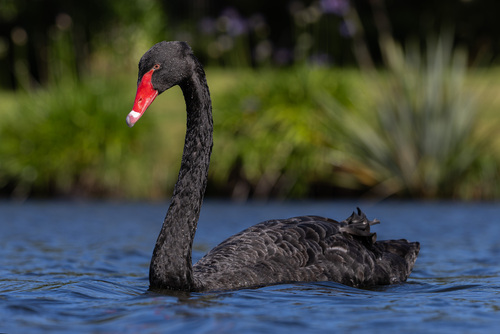
The black swan, scientifically named Cygnus atratus (Latham, 1790), is a water bird with distinctive physical traits. Adult black swans have entirely black body feathers and white flight feathers. Their bill is bright red with a pale bar and pale tip, and their legs and feet are greyish-black. Males, called cobs, are slightly larger than females, called pens, and have longer, straighter bills. Immature birds, called cygnets, are greyish-brown with pale edges on their feathers. Mature individuals measure 110 to 142 centimetres (43 to 56 inches) in length, weigh 3.7 to 9 kilograms (8.2 to 19.8 pounds), and have a wingspan between 1.6 and 2 metres (5.2 and 6.6 feet). They have a long S-curved neck, which is proportionally the longest neck of any swan species. Black swans produce a musical, far-carrying bugle-like call that can be heard while they are on the water or in flight, along with a range of softer crooning notes. They can also whistle, especially when disturbed during breeding and nesting. When swimming, black swans hold their necks either arched or erect, and often raise their feathers or wings as an aggressive display. In flight, groups of black swans form a line or V-shaped wedge; individual birds fly strongly with long, undulating necks, produce whistling sounds with their wings, and make baying, bugling, or trumpeting calls. No other Australian bird matches the black swan's appearance, though it can be confused with the magpie goose when seen in poor light at long range while in flight. The black swan can be distinguished by its much longer neck and slower wing beat. One captive population in Lakeland, Florida has produced a small number of individuals with light mottled grey plumage instead of black. Rare white black swans also occur; these are leucistic individuals that are rarely found in the wild. The black swan is common across wetlands in southwestern and eastern Australia, as well as on adjacent coastal islands. In the southwest, its range covers the area between North West Cape, Cape Leeuwin, and Eucla. In the east, it occupies a large region bounded by the Atherton Tableland, the Eyre Peninsula, and Tasmania, and the Murray–Darling basin supports very large populations of the species. It is uncommon in central and northern Australia. Its preferred habitat includes fresh, brackish, and salt water lakes, swamps, and rivers that hold underwater and emergent vegetation the birds use for food and nesting materials. It favors permanent wetlands, including ornamental lakes, but can also be found in flooded pastures and tidal mudflats, and occasionally on the open sea near islands or shore. Black swans were once thought to be sedentary, but are now known to be highly nomadic. They do not follow a fixed migratory pattern, instead moving opportunistically in response to rainfall or drought. In wet years with high rainfall, black swans move from the southwest and southeast into the Australian interior, and reverse this migration back to these core areas in drier years. When rain falls in arid central regions, black swans migrate there to nest and raise their young. If dry conditions return before cygnets are fully grown, adult birds will abandon their nests, leaving behind eggs or young cygnets, and return to wetter areas. Like many other waterfowl, black swans shed all their flight feathers at once during a post-breeding moult, and are unable to fly for around one month. During this flightless period, they usually stay on large, open bodies of water for safety. The species has an extent of occurrence between 1 and 10 million square kilometers. The total global population is estimated to number up to 500,000 individuals. This numerous, widespread species faces no threat of extinction, and no significant population decline has been identified. Europeans first observed black swans in 1697, when Willem de Vlamingh's expedition explored the Swan River in Western Australia. Like other swans, the black swan is largely monogamous, and most pairs bond for life; around 6% of pairs end in divorce. Recent research has found that around one third of all broods have extra-pair paternity. An estimated one quarter of all pairings are homosexual, most between males. Homosexual male pairs steal nests, or form temporary threesomes with females to obtain eggs, driving the female away after she lays eggs. In the Southern hemisphere, black swans generally nest during the wetter winter months, from February to September, and occasionally nest in large colonies. A black swan nest is a large mound or heap of reeds, grasses, and weeds. It measures between 1 and 1.5 meters (3 to 4 and a half feet) in diameter, and can grow up to 1 meter high. Nests are built in shallow water or on islands, and are reused each year, with pairs restoring or rebuilding the nest as needed. Both parents share care of the nest. A typical clutch holds four to eight greenish-white eggs, which are incubated for roughly 35 to 40 days. Incubation does not begin until the last egg is laid, so all chicks hatch at the same time. Before incubation starts, parents sit over the eggs without actively warming them. Both sexes take turns incubating eggs, with the female incubating overnight. Switching between incubation shifts is marked by ritualized displays from both parents. If an egg accidentally rolls out of the nest, both sexes will retrieve it using their neck; in other swan species, only the female performs this action. Like all swans, black swans aggressively defend their nests using their wings and beaks. After hatching, cygnets are cared for by their parents for approximately nine months until they fledge. Cygnets may ride on their parent's back for longer trips into deeper water, but black swans do this behaviour less often than mute swans and black-necked swans.