About Cycnia tenera Hübner, 1818
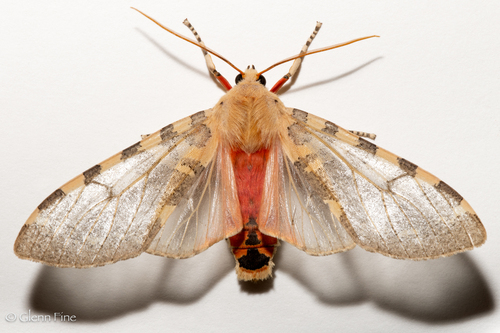
Cycnia tenera, commonly known as the dogbane tiger moth or delicate cycnia, is a member of the moth family Erebidae. This species is found across North America, ranging from southern British Columbia to Nova Scotia, and extending south to Arizona and Florida. The moth has a distasteful chemical profile, and it is known to produce aposematic ultrasound signals. These signals may also function to jam bat echolocation, as the two proposed roles are not mutually exclusive. In terms of ecology, the species commonly feeds on Apocynum cannabinum, also called dogbane or Indian hemp. This plant produces a milky latex that contains cardenolides, which are toxic cardiac glycosides that evolved to defend the plant against herbivores. Across at least part of this moth's range, it also feeds on milkweed species of the genus Asclepias, though it is most commonly reported feeding on dogbane. The interactions between Cycnia tenera and bats have been heavily studied, and there is ongoing scientific dispute over whether the clicking sounds produced by adult moths disrupt bat echolocation, or act only as aposematic warning signals. Since these two functions are not mutually exclusive, it may not be possible to definitively resolve this question. The moth's visible coloration acts as an aposematic warning to insectivorous birds. While chemical signals from the moth do not stop bats from attacking, they do cause bats to release any C. tenera they have already caught. For its life cycle, this moth produces several generations per year across most of its range, so caterpillars can be found from June through November. Females lay eggs in clutches of 50 to 100 eggs. Larvae have been reported to feed in groups of five to seven individuals, at least during their early instar stages. Caterpillars are entirely covered in soft grey to whitish hairs, and they feed at night. The cocoon the caterpillar forms is grayish, and is covered in hairs shed from the caterpillar's body. Adult moths have white wings, with a buttery yellow margin along the front edge of the forewing, and their legs are black. The underside of the forewing may have a light dusting of black scales. The moth's body is yellow, with a single row of black spots along its length. The adult wingspan measures between 30 and 40 millimetres, or 1.2 to 1.6 inches.