About Cyclosa turbinata (Walckenaer, 1841)
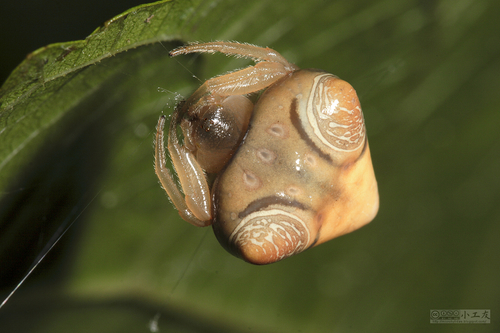
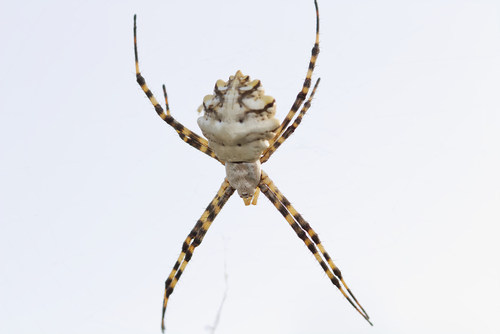
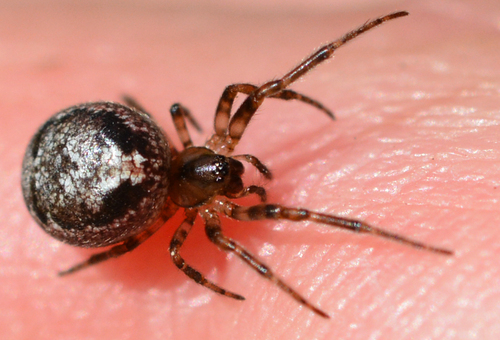
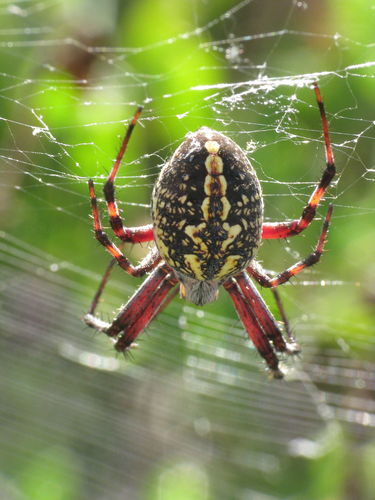
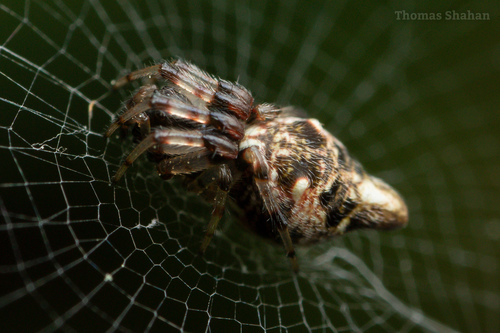
Cyclosa turbinata is a relatively small spider species, with a total body length ranging from around 4 to 7 mm. Females typically measure between 3.3 and 5.2 mm in body length, while males have an average body length of 2.5 mm. Their coloration is a mixture of brown, black, and white, and their abdomen tapers to a rounded point, which is the origin of the species' name. Males are most active between March and September, and females are active from March to October. Female Cyclosa turbinata can be distinguished from females of the very similar species Cyclosa conica by their smaller size and the presence of two anterior dorsal humps. Mangora gibberosa, the lined orbweaver, is also commonly misidentified as C. turbinata, due to their similar appearance and the fact that both build orb-style webs.
This spider is native to the continental United States and Mexico, but it has been introduced to and recorded in Hawaii, the Caribbean, Central and South America, the Galapagos Islands, and Oceania. Its wide geographic range is likely the result of its ability to travel on wind currents using silk. Five species of the genus Cyclosa occur in the continental United States, and five Cyclosa species occur in North America north of Mexico. These species differ in where they position their webs within vegetation, so species diversity is highest in habitats with high architectural and botanical diversity.
Cyclosa turbinata is found across North America, Mexico, and the northern regions of South America. It is extremely common along forest edges and fencing. This species has been recorded on cotton and peanut crops, grassland pastures, sand dunes, shrubs, and pecan orchards, as well as on a variety of plants including bluebonnets, croton, prickly pear, Baccharis, and Monarda citriodora. In woodland habitats, it favors live oak trees, specifically Quercus buckleyi and Quercus virginiana, and Ulmus crassifolia trees, building its webs in hollow sycamore trees or within shrubs. The wide distribution of this species is attributed to the efficient aerial dispersal of its young via wind currents. To disperse, a spiderling first climbs onto an elevated perch, then extends a silk line out into the air. When the wind catches the silk and the pull on the line becomes strong enough, the spiderling releases its grip on the perch and travels through the air, allowing the species to colonize large areas of land.
Cyclosa turbinata is bivoltine, meaning it produces two generations per year: one generation reproduces in late spring, and a second reproduces in the fall. A 1984 study confirmed that the species has two generations annually. The first generation matures and reproduces in late spring, then dies in early summer. The second generation matures and reproduces over the summer, then dies in fall and winter. C. turbinata reaches full maturation in the spring. Once mature, males do not spin webs; instead, they leave their original webs to search for mates. Females continue to spin webs. After mating, a female can produce up to five egg sacs, which she hides in the surrounding foliage.