About Cyclophora puppillaria (Hübner)
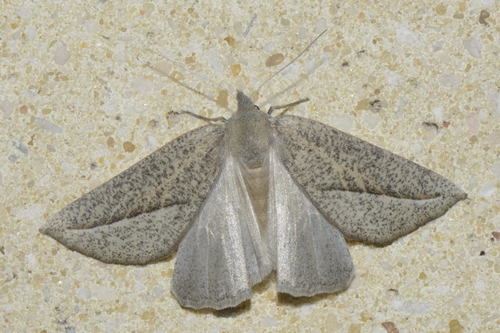
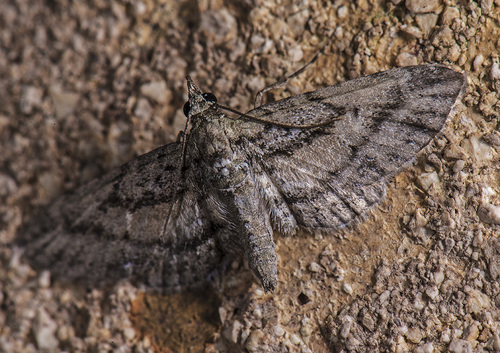
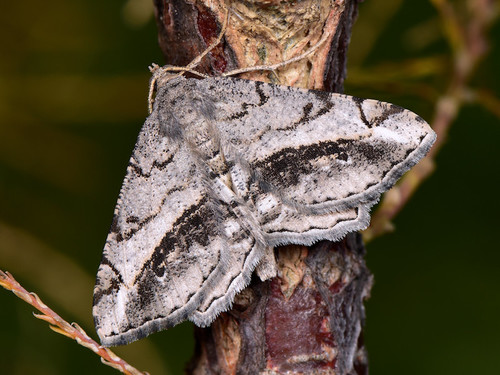
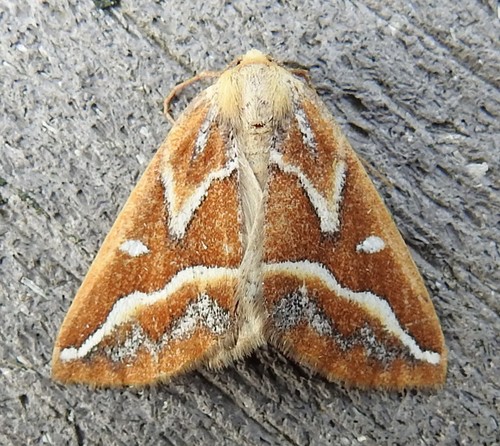
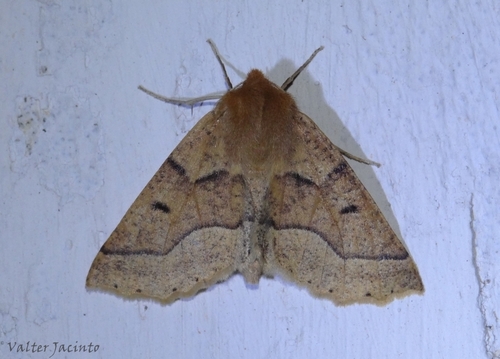
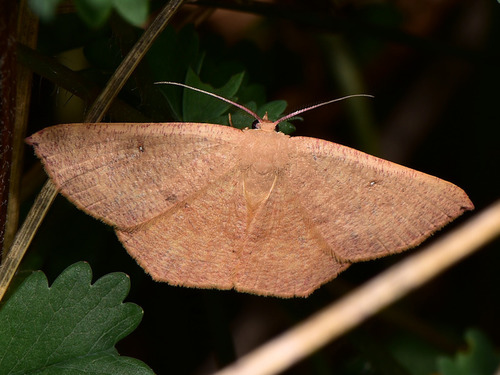
Cyclophora puppillaria (Hübner) has a wingspan of 28–36 mm for individuals from the first generation. Members of the second generation, and any subsequent generations, are on average much smaller, often reaching only 19 mm in wingspan. The forewings and hindwings are almost the same colour. This base colouration is very variable, most commonly ranging from reddish brown to reddish yellow and light brown. Some individual specimens are sand coloured, brown, or orange. The wing pattern of this species is also very variable. The inner and outer cross lines, as well as the median band, can be very well developed, or may be almost completely missing. The inner cross line, and especially the outer cross line, is often replaced by a row of dots. Discal spots on the forewings and hindwings can be large, small, or completely absent. In specimens that have large discal spots, these spots often have white pupils. Marginal stains present on the hindwings are mostly absent from the forewings. The basal half of the costa is often dark. Noticeable spots usually develop where the inner and outer cross lines reach the costa of the forewings. The wing fringes usually match the colour of the wings. The Madeiran subspecies lilacinipes has a dark fringe. These moths fly from June to October, depending on their location. The larvae feed on oak. This species is widespread across the Mediterranean region. Its range extends from the Iberian Peninsula and Morocco in the west to Greece, Asia Minor, and Egypt in the east. It occurs on all major Mediterranean islands. Its range continues through the Crimea and the Caucasus area to Iran, and possibly Afghanistan. In France, it occurs in southern France and along the Atlantic coast as far north as southern Brittany. Further east, the northernmost permanent populations are found in Hungary. This is a migratory species, so it can be found in summer north of the Alps, in southern England, Denmark, southern Sweden, and southern Finland. The populations on Madeira and the Azores are classified as separate subspecies: C. p. lilacinipes on Madeira, and C. p. granti on the Azores.