About Cyclophora annularia (Fabricius, 1775)
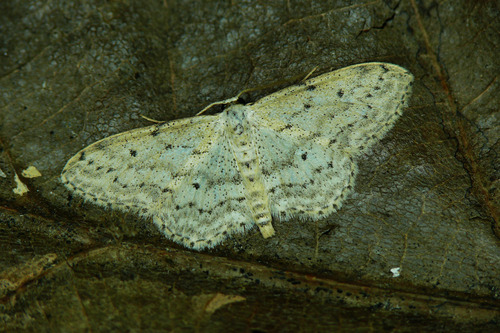
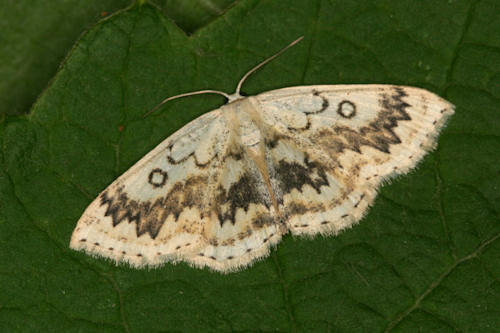
Cyclophora annularia, commonly called the mocha, is a moth species belonging to the family Geometridae. It was first formally described by Johan Christian Fabricius in 1775, and it is found in Europe. This moth has a wingspan ranging from 18 to 22 millimetres, which equals 0.71 to 0.87 inches. Typically, the wings of this species are yellowish white, tinting toward an ochreous yellow shade. Both the forewings and hindwings have a blackish central shade positioned close to an irregular, outwardly toothed blackish second cross line, and these two dark features are sometimes united. The characteristic annular rings on the wings are deep brown or blackish. The width and intensity of the central shade vary between individuals. Occasionally, the rings are absent from the forewings, a variant form named ab. obsoleta by Riding. More rarely, all wings lack the annular mark entirely, a variant named ab. biobsoleta by Riding. Individuals of the second generation reared in captivity are usually noticeably darker in overall color, and have a scattering of black scales concentrated mostly on their forewings. The caterpillar is dark green, with yellow coloring between its body segments. It has three yellow lines running along its back, and the outermost of these lines are wavy. The caterpillar's head is reddish brown with paler markings. A pale ochreous brown color form of the caterpillar also exists. Adult moths are active and in flight from May to August, with the timing varying based on location. The larvae feed on the leaves of maple trees. The common name 'mocha' comes from the species' supposed resemblance to the Mocha stone.