About Cyclopes didactylus (Linnaeus, 1758)
Species Classification and Relative Size
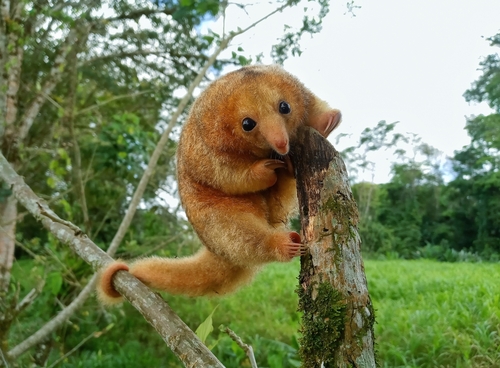
Silky anteaters (Cyclopes didactylus) are the smallest living anteaters. Compared to other anteater species, they have proportionally shorter faces and larger crania.
Body Size and Weight
Average adult individuals measure 36 to 45 cm (14 to 18 in) in total length, which includes a 17 to 24 cm (6.7 to 9.4 in) long tail, and weigh between 175 and 400 g (6.2 to 14.1 oz).
Fur Coloration
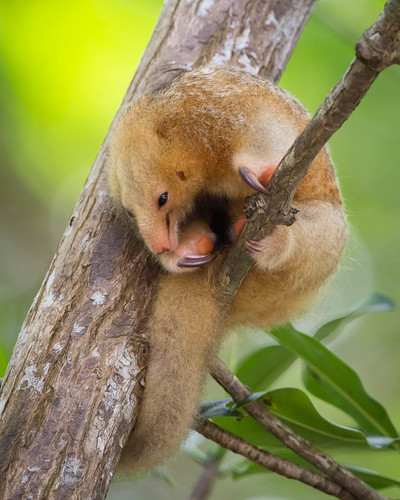
They have dense, soft fur that ranges in color from grey to yellowish, with a distinct silvery sheen. Most subspecies have dark, often brownish streaks, and their underparts or limbs are relatively paler.
Soft Tissue Features
Their eyes are black, and the soles of their feet are red.
Forefoot Claw Structure
On their forefeet, silky anteaters have claws on the second and third toes, with the third toe being noticeably larger. The fourth toe is small and lacks a claw, while the other remaining toes are vestigial or completely absent, and are not visible from the outside.
Hind Foot Structure
On their hind feet, all four toes are the same length, have long claws, and there is an externaly invisible vestigial hallux.
Rib Structure
Their ribs are broad and flat, and overlap to form an internal armored casing that protects the chest.
Tail Adaptation
This species also has a partially prehensile tail that helps support its arboreal (tree-dwelling) lifestyle.
Geographic Distribution
Silky anteaters range from Oaxaca and southern Veracruz in Mexico, through Central America (with the exception of El Salvador), and south to Ecuador, northern Peru, Bolivia, and Brazil. There is a separate, distinct population in the northern Atlantic Forest of eastern Brazil. They are also found on the island of Trinidad.
Habitat and Elevation Range
They live in multiple forest types, including semi-deciduous forest, tropical evergreen forest, and mangrove forest, at elevations from sea level up to 1,500 m (4,900 ft).