About Cycloneda sanguinea (Linnaeus, 1763)
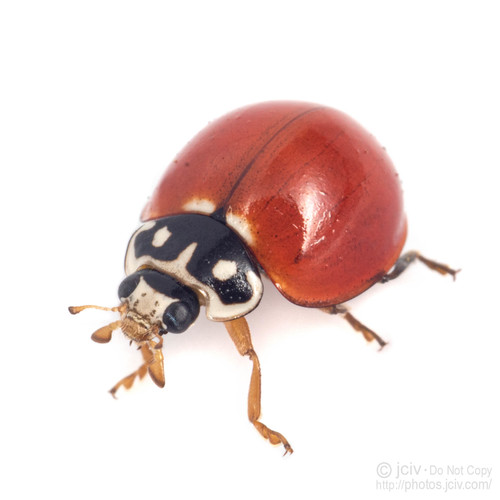
Cycloneda sanguinea is a large ladybird beetle that ranges from 4 to 6.5 mm in length. It has red, spotless elytra, or wing covers, and its body color can vary from orange to deep red. The white and black markings on the head and pronotum are highly distinctive and differ by gender. Both females and males have white spots on their black head region, but females have black coloration in the center that extends down into the face, while males have a white cleft above the head and an entirely white face. These ladybugs are most often found feeding on aphids on milkweeds, though they also live on many other types of plants. Their eggs are usually orange or yellow, and measure around 1 mm in diameter. Fully grown larvae reach up to 6 mm in length, and are black with yellow markings. Pupae start out pale and eventually turn brown or orange, and they have a unique ability to 'bite' potential predators using a structure called a 'gin trap'. Cycloneda sanguinea is the most widespread ladybird beetle in Latin America. It occurs in plant-dense landscapes across a range extending from the southern United States to Argentina, and eastward to the Cayman Islands. There are several ladybeetle species that look similar to this spotless ladybeetle. On the Galápagos Islands, Cycloneda sanguinea lives in sympatry with its sister species, Cycloneda galapagensis.