About Cyclocodon lancifolius (Roxb.) Kurz
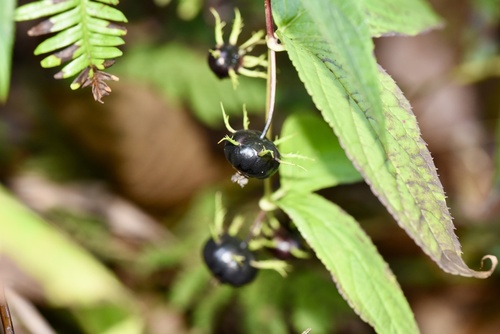
Cyclocodon lancifolius is a herbaceous plant that may be either perennial or annual. It typically grows with upright, usually branched stems. At full maturity, stems reach heights between 30 cm (1 ft) and 3 m (9.8 ft), and may become woody at the base. Stems are hollow, and the entire plant is usually hairless. The leaves are most commonly arranged oppositely along the stem, but occasionally grow in whorls of three. Leaf shapes range from ovate (egg-shaped) and ovate-lanceolate to lanceolate (spear-head shaped), and measure 5–15 cm (2–6 in) long by 1–5 cm (0.4–2.0 in) wide. This species produces a purple-black berry fruit 5–10 mm (0.20–0.39 in) in diameter, which contains numerous elliptic, flattened seeds. The native range of Cyclocodon lancifolius extends from northeast India, through Southeast Asia, to Japan. Areas adjacent and east of India within its range include Bangladesh, Cambodia, Myanmar, Nepal, Laos, and Vietnam. In the Indonesian archipelago, it grows in Borneo, Java, the Maluku Islands, New Guinea, Sulawesi, and Sumatera. In mainland China, it has been recorded in Chongqing, south Fujian, Guangdong, Guangxi, Guizhou, southwest Hubei, southern and western Hunan, southern Jiangxi, Sichuan, and southeast Yunnan; it also grows on the islands of Hainan and Taiwan. It is additionally found in the Ryukyu Islands of Japan and in the Philippines. It grows in a variety of habitats including forests, thickets, and grasslands, at altitudes up to 1,500 m (4,900 ft). Its berries are edible, and its roots and leaves are used in folk medicine by ethnic minorities in Guizhou and Hunan Provinces, China.