About Cyclamen persicum Mill.
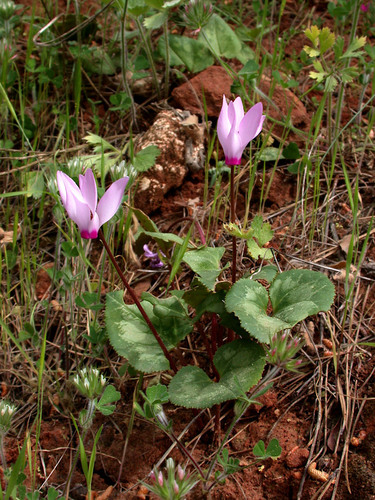
Cyclamen persicum Mill. is a perennial herbaceous plant that grows to approximately 32 cm (13 in) tall. Wild individuals produce heart-shaped, fleshy leaves that can reach up to 14 cm (6 in) across; leaf upper surfaces are typically green with lighter markings, while leaf undersides may be pale green or reddish. Leaf margins are slightly thickened and usually serrated. As a perennial storage and survival organ, C. persicum forms a hypocotyl tuber, which develops solely from thickening of the hypocotyl—the region of the shoot axis between the root neck and the first cotyledon. The tuber is rounded and slightly flattened, with a corky texture, and reaches 4 to 15 cm (1.6 to 5.9 in) or more in diameter. Roots grow from the underside of the tuber, while the tops of spirally arranged, long-stalked leaves emerge from the tuber's upper surface. The natural distribution of C. persicum ranges from North Africa, through Southeast Europe, to West Asia. Documented specific occurrences include northern and eastern Algeria and northern Tunisia in North Africa; Cyprus, Lebanon, Israel, western Syria, and western Turkey in Western Asia; and the Greek islands of Rhodes, Karpathos, and Crete, where the species may have been introduced by monks. Its preferred habitats are pine forests, oak thickets, and open rocky slopes, most often on calcareous soils, at altitudes up to 1,000 metres (3,300 ft). In summer, high temperatures and dry conditions kill all above-ground plant parts. C. persicum survives the dry season as a shallow subterranean tuber, and resumes growth when the cooler season begins. This species was likely brought to Paris before its first written mention in 1620, and has been definitely cultivated in France since 1731. Systematic variety breeding for C. persicum began in the 1860s, starting in England. All existing cultivated varieties were produced by breeding only from variants of the wild species, with no introgression of genetic material from other Cyclamen species. C. persicum has a dark-brown tuberous root that is semi-poisonous. In some cultures, the tubers have been used to make soap, because they produce lather when mixed with water. Bedouins in Mandate Palestine traditionally collected the root, grated it, mixed it with lime, and sprinkled the mixture over lakes and other large bodies of water that contained fish. The poisonous mixture stunned fish, which then floated to the surface for collection. This fishing method, alongside fishing with explosives that became common in the early 20th century, was banned by British Mandate authorities. C. persicum is propagated by seed. Seeds germinate best when very fresh, as they do not remain viable for long periods. Cyclamen seeds are dark germinators, meaning they require covering with soil and placement in near or total darkness to germinate. The optimal germination temperature is 18 °C (64 °F), and germination takes 20 to 30 days. Seed boxes are moved to brighter conditions after germination. With proper care, Cyclamen persicum plants can live 20 to 30 years.