About Cyclachaena xanthiifolia (Nutt.) Fresen.
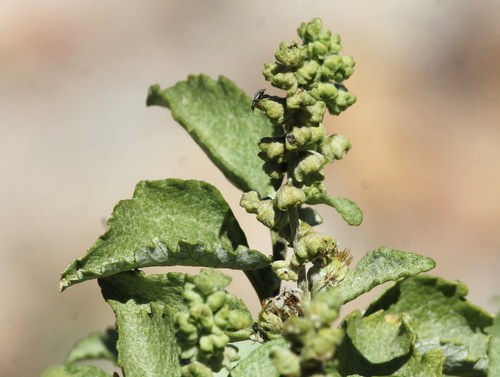
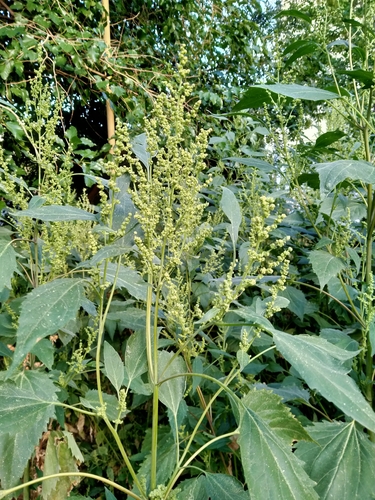
Cyclachaena xanthiifolia (Nutt.) Fresen. is an herbaceous plant. Its leaves are arranged oppositely along the stem, and this arrangement sometimes shifts to alternate near the top of the plant. All leaves are long-stalked with double-toothed edges; the upper leaf surface is covered in rough hairs, while the lower surface is light green and fuzzy. Lower leaves have stalks that reach up to 70 mm (2+3⁄4 in) or longer, and upper leaves have shorter stalks that reach up to 10 mm (3⁄8 in) or longer. Flowers are green to white, arranged in panicled spikes that are roughly 25 cm (10 in) long. Flowering occurs between August and October. Some flowers are pistillate and fertile, while others are perfect but sterile. Individual flower heads droop at the end of a stalk that measures 5 to 6.5 mm (3⁄16 to 1⁄4 in) or longer. The involucre, a whorl of bracts at the base of the flower head, is 2 to 3 mm (1⁄16 to 1⁄8 in) long. The flower head has a central disk made of 8 to 20 staminate (male) florets, usually no more than 10, with typically 5 pistillate (female) florets arranged around the outer margin. Staminate florets have stamens with filaments fused into a tube, and free anthers that are closely arranged in a ring. Their corolla is about 2 mm (1⁄16 in) long and white to pale yellow. Pistillate florets also have stamens with filaments fused into a tube and free anthers arranged closely in a ring, though the corolla is sometimes entirely absent. If a corolla is present, it measures about 0.4 mm (1⁄64 in) long and is whitish in color. The fruit is an egg-shaped achene, ranging from dark brown to nearly black, 2 to 3 mm (1⁄16 to 1⁄8 in) long, with a tuft of hairs attached to one end. Cyclachaena xanthiifolia grows in moist areas, previously disturbed sites, fields, and alongside roadsides and streams.