About Cycas thouarsii R.Br. ex Gaudich.
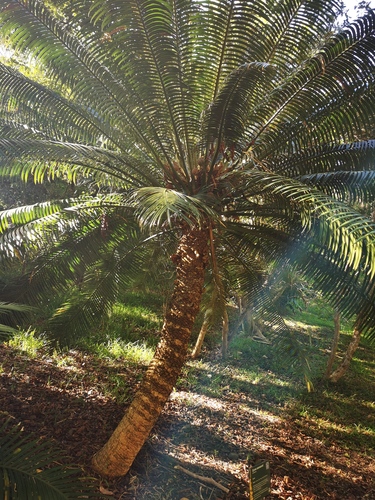
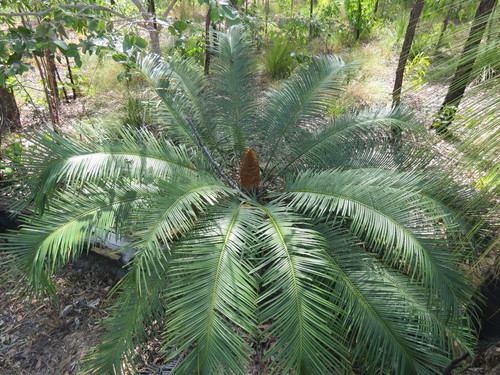
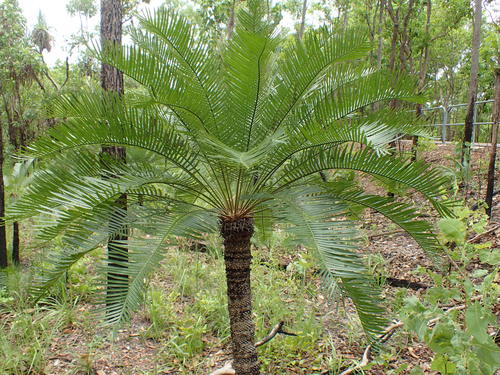
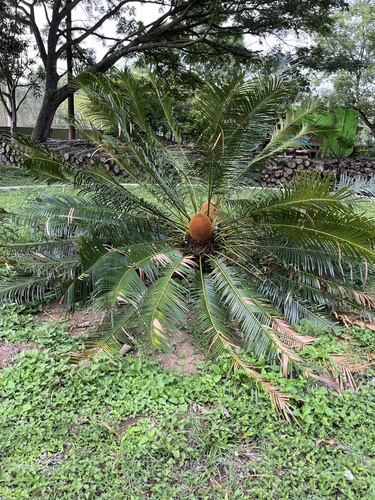
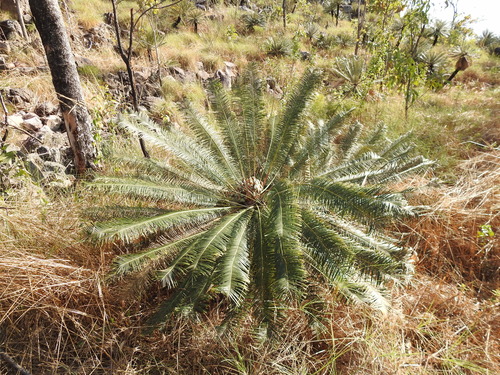
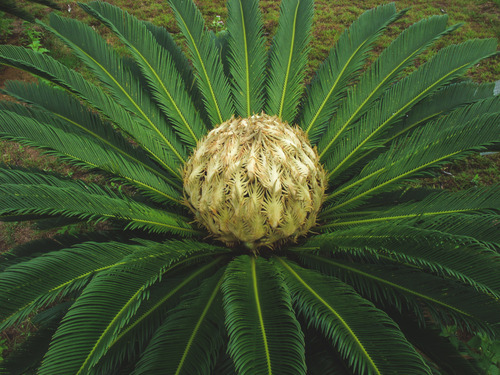
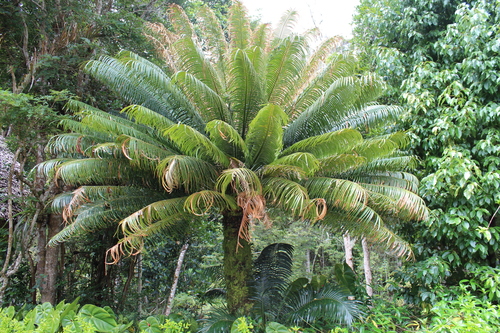
Cycas thouarsii R.Br. ex Gaudich. has a palm-like cycad stem that grows 4 to 10 meters tall, reaching up to 45 cm in diameter. Its large photosynthetic leaves are arranged spirally along the stem, and are interspersed with many brown, hairy, triangular scale-like leaves. The photosynthetic leaves are pinnate, dark green, and somewhat glossy, usually measuring 150 to 300 centimeters long, with 60 to 120 leaflets per side. Leaflets are around 17 cm long, lanceolate, with slightly bent margins, and a midrib that is more prominent on the paler lower surface. The leaf stalk is 40 to 50 cm long, and has two rows of spines along almost its entire length. Emerging leaves are hairy with involute vernation, and young leaves have a distinct bluish tint that sets this species apart from its close relatives Cycas rumphii and Cycas circinalis. The spindle-shaped pollen cone is 30 to 60 cm high and 10 to 15 cm in diameter, ranging in color from orange to pale brown. Pollen cone scales have a sharp apical spine. Ovulate cones are made up of overlapping, yellow, hairy megasporophylls. Each megasporophyll is 29 to 32 centimeters long, with 5 to 13 marginal teeth per side, and bears 4 to 10 ovules along its edges. Seeds are ovoid, 50 to 60 millimeters in size, with a red-brown fleshy seed coat and a spongy endocarp. This spongy endocarp is a defining characteristic of the species, and it allows seeds to float. This cycad, commonly called the Madagascar cycad, is native to Madagascar, the nearby Comoros, Mayotte, and the Seychelles, and also grows along the coasts of Kenya, Mozambique, and Tanzania. Some sources note a presence in Sri Lanka, but this is likely a confusion with the closely related Cycas circinalis. It grows up to 200 meters above sea level, in open forests and on forest edges, or near coastal areas on sandy soil or coral formations. These habitats receive between 1000 and 3000 millimeters of annual precipitation. The species is uncommon as both individual plants and in group communities, and its populations have been negatively affected by plant collectors, development of seaside resorts, and agricultural expansion. Despite these impacts, there is no immediate threat to the species, and it is classified as Least Concern on the IUCN Red List. As a relatively fast-growing cycad, Cycas thouarsii is sometimes grown as a specimen plant in horticulture. It needs moist but well-drained soil, and tolerates full shade, partial shade, and full sun when sufficient humidity is available. It is only hardy to very light frost, and can tolerate brief exposure to temperatures as low as −3.9 °C (25 °F, corresponding to USDA hardiness zone 9b), though this exposure causes leaf scorching. Though the seeds are toxic, they are eaten on the Comorian island of Ngazidja, especially in the Hamahame and Washili regions, where this plant—known locally as ntsambu—holds cultural significance. Cyanotoxins are removed from the seeds through a repeated process of washing, fermentation, and drying to make the seeds edible.