About Cyathus stercoreus (Schwein.) De Toni
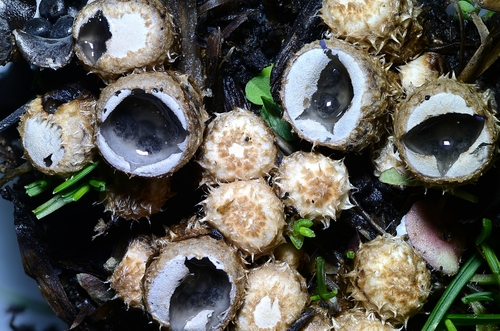
The scientific name of this fungus is Cyathus stercoreus (Schwein.) De Toni. Its fruiting bodies, called peridia, are funnel- or barrel-shaped, measuring 6–15 mm tall and 4–8 mm wide at the mouth. They sometimes have a short stalk, and their color ranges from golden brown to blackish brown as they age. The outer wall of the peridium, called the ectoperidium, is covered in tufts of fungal hyphae that look like shaggy, messy hair. In older specimens, this outer hairy layer (technically called a tomentum) may be completely worn away. The inner wall of the cup, the endoperidium, is smooth, and colored grey to bluish-black. The "eggs" of this bird's nest fungus, called peridioles, are blackish, 1–2 mm in diameter, and there are typically around 20 peridioles in each fruiting body cup. Peridioles are often attached to the fruiting body by a funiculus, a hyphal structure divided into three regions: a basal piece that attaches the funiculus to the inner peridium wall, a middle piece, and an upper sheath called the purse that connects to the lower surface of the peridiole. A coiled thread of interwoven hyphae called the funicular cord lies inside the purse and middle piece; it is attached at one end to the peridiole, and at the other end to a tangled mass of hyphae called the hapteron. However, Brodie has recorded that C. stercoreus sometimes occurs without a funiculus, which has led some authors to misidentify this species as a member of the genus Nidula. The spores of C. stercoreus are roughly spherical and relatively large, with typical dimensions of 20–35 x 20–25 μm, though high variability in spore size has been observed. The spores are sessile, meaning they grow directly from the surface of the basidium without attaching via a sterigma. They separate from the basidia after the basidium collapses and gelatinizes, a process that is accompanied by gelatinization of the inner walls of the peridiole. Cyathus stercoreus is coprophilous, meaning it grows on dung, in soil that contains dung, and on bonfire sites; it has also been recorded growing on sand dunes. This fungus has a worldwide distribution. In his monograph on the Nidulariaceae, Curtis Gates Lloyd wrote that it "probably occurs in every country where manure occurs". The life cycle of C. stercoreus includes both haploid and diploid stages, and follows the typical pattern for basidiomycetes that can reproduce both asexually via vegetative spores and sexually via meiosis. Each basidiospore produced in the peridioles contains a single haploid nucleus. After dispersal, spores germinate and grow into homokaryotic hyphae, which have a single nucleus in each compartment. When two homokaryotic hyphae from different mating compatibility groups fuse, they form dikaryotic mycelia (which contain two nuclei each) in a process called plasmogamy. After a period of time (around 40 days when grown from pure culture in the laboratory) and under suitable environmental conditions, fruiting bodies can develop from the dikaryotic mycelia. These fruiting bodies produce peridioles that contain basidia, on which new basidiospores develop. Young basidia hold a pair of haploid sexually compatible nuclei that fuse; the resulting diploid fusion nucleus then undergoes meiosis to produce haploid basidiospores. Cyathus stercoreus is inedible, but has other uses. In Traditional Chinese medicine, a decoction of this fungus is used to help relieve symptoms of gastralgia, or stomach ache.