About Cyanothamnus polygalifolius (Sm.) Duretto & Heslewood
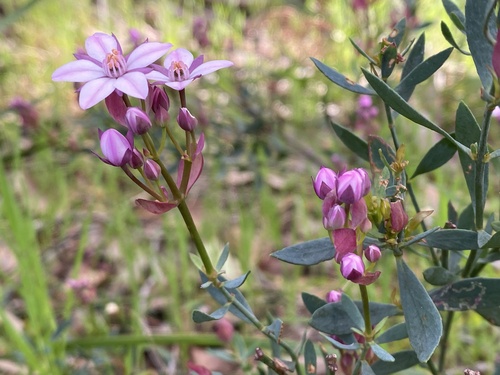
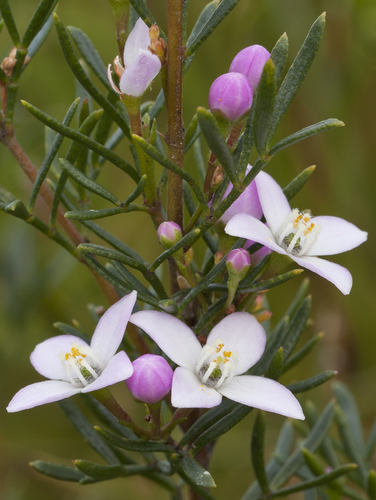
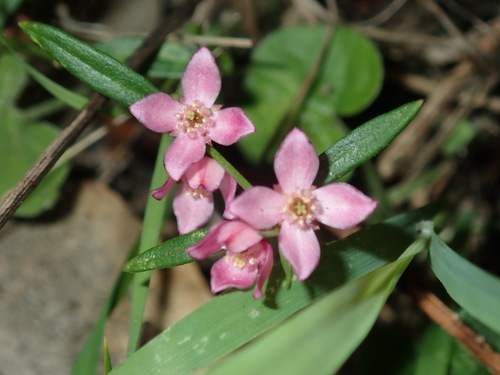
Cyanothamnus polygalifolius, commonly called dwarf boronia, is a low-lying, spreading shrub that typically reaches around 0.3 meters (0.98 feet) in height, with branches that are also usually around 0.3 meters (0.98 feet) long. The entire plant is glabrous, meaning hairless, except for its flowers. Its leaves are simple, usually sessile, ranging in shape from linear to elliptic. They measure 6 to 30 millimeters (0.24 to 1.18 inches) long and 1 to 6 millimeters (0.039 to 0.236 inches) wide, with edges that are down-curved or rolled under. Flowers are usually borne singly, sometimes in groups of up to three, arranged in leaf axils on a pedicel 1 to 11 millimeters (0.039 to 0.433 inches) long. This species has four glabrous sepals that range in shape from egg-shaped to triangular, measuring 1.5 to 2 millimeters (0.059 to 0.079 inches) long and 1 to 1.5 millimeters (0.039 to 0.059 inches) wide. The four petals are pink or white, 4.5 to 6.5 millimeters (0.18 to 0.26 inches) long, with overlapping bases. The eight stamens have hairy edges. Flowering occurs mainly from September to January, and the fruit is a glabrous capsule 4 to 5 millimeters (0.16 to 0.20 inches) long. This plant grows in open forest, woodland and heath, with its main range between Blackdown Tableland and Kroombit Tops in Queensland, and between Moruya and Geehi in New South Wales. A single specimen has been recorded in eastern Victoria.