About Cyanothamnus nanus (Hook.) Duretto & Heslewood
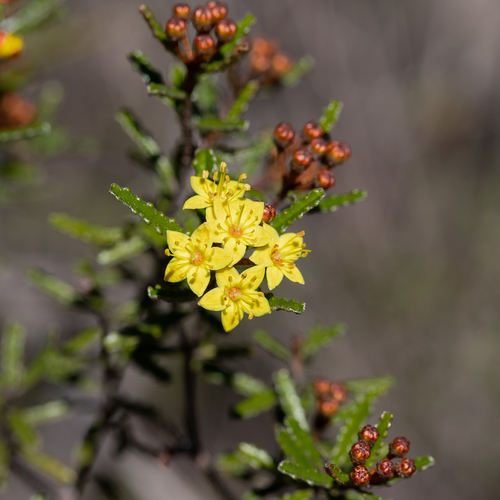
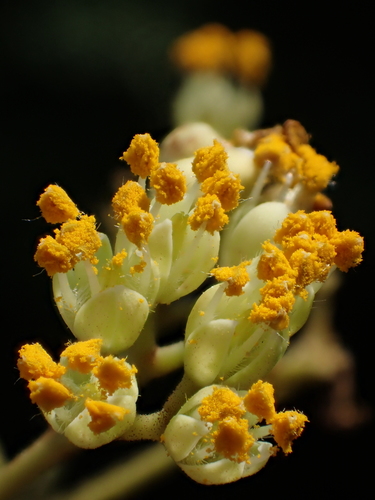
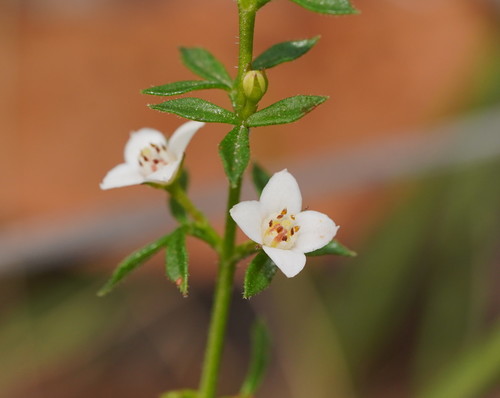
Cyanothamnus nanus (Hook.) Duretto & Heslewood is a prostrate shrub, or a shrub with weak, spreading branches. It grows to around 25 cm (10 in) wide and 50 cm (20 in) high. Its youngest branches bear a few soft hairs, and become glabrous as they mature. Leaves are either simple or trifoliate, growing on a petiole up to 5 mm (0.2 in) long. Leaves or individual leaflets range in shape from linear to elliptic or egg-shaped, and measure 2–15 mm (0.08–0.6 in) long and 0.5–3.5 mm (0.02–0.1 in) wide. The flowers are white to pale pink, and are arranged singly or in groups of up to three or more in leaf axils. Flower groups grow on a peduncle 1–7 mm (0.04–0.3 in) long, with individual flowers borne on a pedicel 2–16 mm (0.08–0.6 in) long. The four sepals are triangular to broadly egg-shaped, 1–3.5 mm (0.04–0.1 in) long and 0.5–1.5 mm (0.02–0.06 in) wide, and overlap at their bases. The four petals are 3–5.5 mm (0.1–0.2 in) long, 1.2–3 mm (0.05–0.1 in) wide, and also overlap at their bases. The stamens are covered in long, soft hairs. Flowering takes place from October to February. Three varieties of this species have different distributions and habitat preferences. Cyanothamnus nanus var. hyssopifolius grows in woodland, forest and heath. It is the only variety of this species found in New South Wales, where it occurs south from the Blue Mountains. It also grows in central and eastern Victoria, the far southeast corner of South Australia, and the eastern half of Tasmania. Cyanothamnus nanus var. nanus grows in heath and heathy woodland, and occurs mostly in south-west Victoria and the far south-east of South Australia. Cyanothamnus nanus var. pubescens grows in rocky soils in open forest, woodland and heath, and occurs mainly between the Grampians and Lexton in Victoria, and in the far south-east of South Australia.