About Cyanothamnus anemonifolius (A.Cunn.) Duretto & Heslewood
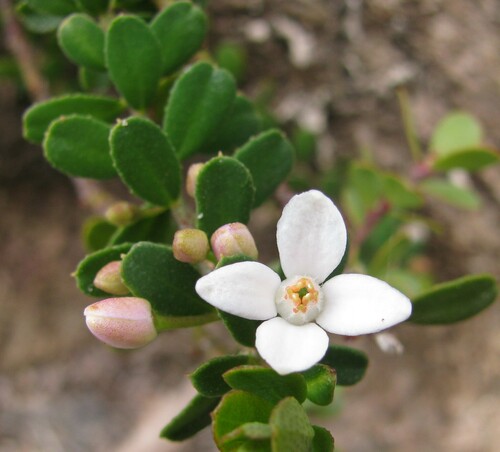
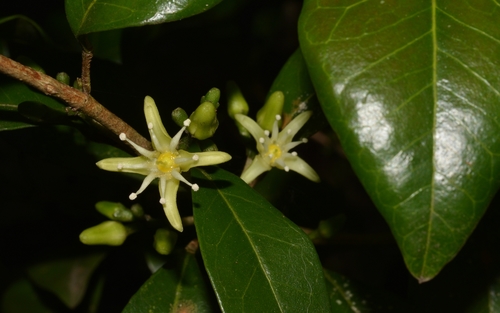
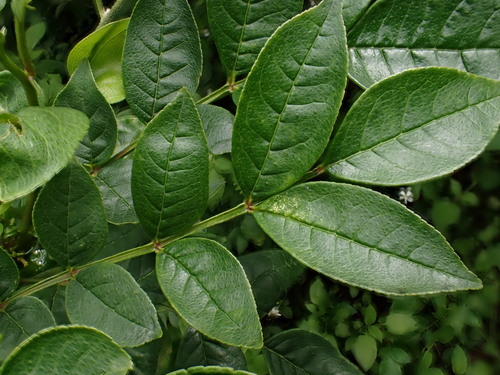
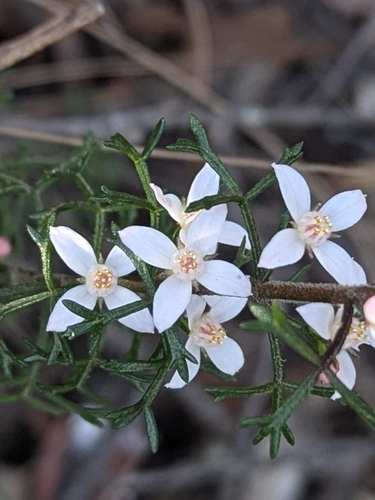
Cyanothamnus anemonifolius is an erect shrub that grows up to 2.5 metres (8 feet 2 inches) tall, and has pimply glands covering its branches. Its leaves are most commonly pinnate, but sometimes simple or bipinnate. Most leaves have an overall outline length of 4–18 mm (0.16–0.71 in) and width of 2–25 mm (0.079–0.98 in), and grow on a petiole that is usually 2–9 mm (0.079–0.35 in) long. Leaflets (or blades of simple leaves) are wedge-shaped to elliptic or egg-shaped, and most are 2–9 mm (0.08–0.4 in) long and 1–4 mm (0.04–0.2 in) wide. These leaf structures are the same colour on both sides, and their tip is often divided into three lobes. The flowers of this species are white to pale pink, and are arranged either singly or in groups of up to nine in leaf axils. Each individual flower grows on a pedicel that is 1–8 mm (0.039–0.31 in) long. The four sepals are broadly egg-shaped, 1.5–2.5 mm (0.06–0.1 in) long and 1–1.5 mm (0.04–0.06 in) wide. The four petals are 4–6 mm (0.2–0.24 in) long and 2–3 mm (0.08–0.12 in) wide, with overlapping bases. There are eight stamens total, and the stamens located near the sepals are slightly longer than those closer to the petals. Flowering occurs from August to April, and the fruit is a hairless (glabrous) capsule 3–5 mm (0.12–0.20 in) long and around 2 mm (0.079 in) wide. Four subspecies of Cyanothamnus anemonifolius have distinct distributions and habitat preferences. Subspecies anemonifolius grows in woodland and heath, most often on exposed rocky outcrops. It occurs on the coast and nearby tablelands, ranging from near Rylstone in New South Wales, south to the Brisbane Ranges in Victoria. Subspecies aurifodina grows in low, open eucalypt woodland, and is found only in a small number of locations in central Victoria. Subspecies variabilis is the most widely distributed subspecies. It grows in heath, open woodland or open forest, and occurs in south-east Queensland, the coast and ranges of New South Wales, and northern and south-eastern Tasmania. In Victoria, this subspecies is only found on two islands near Wilsons Promontory. Subspecies wadbilligensis grows in eucalypt woodland or low heath on rocky outcrops, and is found only on the Wadbilliga plateau in New South Wales.