About Cyanopica cyanus (Pallas, 1776)
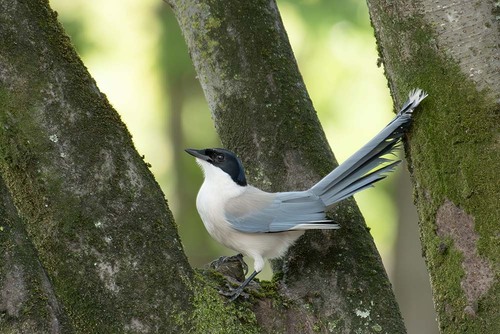
The azure-winged magpie, scientifically named Cyanopica cyanus, is a bird species in the crow family, and is placed in the genus Cyanopica. It measures 31–35 cm in total length. Its overall body shape is similar to that of the Eurasian magpie (Pica pica), but it is more slender, with proportionally smaller legs and bill. It has a glossy black crown, a white throat, and light grey-fawn colored underparts and back. Its wings and the feathers of its long 16–20 cm tail are an azure blue. This species lives in a variety of coniferous forests (mainly pine forests) and broadleaf forests; eastern populations also occupy parks and gardens. The azure-winged magpie has a large distribution range across eastern Asia, found in China, Korea, Japan, and extending north into Mongolia and southern Siberia. The Iberian magpie of southwestern and central Iberian Peninsula, in Spain and Portugal, was previously considered the same species as the azure-winged magpie. However, recent genetic analysis has confirmed that the Iberian magpie is a distinct species; a white-tipped tail is a prominent distinguishing feature. Azure-winged magpies typically forage for food in family groups, and multiple groups may join to form flocks of up to 70 birds. The largest flocks form after the breeding season and remain through the winter months. Their diet is mainly made up of acorns (oak seeds) and pine nuts, and is also extensively supplemented with invertebrates and their larvae, soft fruits and berries, as well as human-provided food scraps in parks and towns. This species usually nests in loose, open colonies, with only one nest per tree. Clutches usually contain 6–8 eggs, which are incubated for 15 days. Azure-winged magpies that raise asynchronous broods, which create a size hierarchy among nestlings, lay more eggs and fledge more young than those that raise synchronous broods. The voice of this species is a quick, metallic-sounding kwink-kwink-kwink, usually preceded by a single krarrah call.