About Cyanolyca turcosa (Bonaparte, 1853)
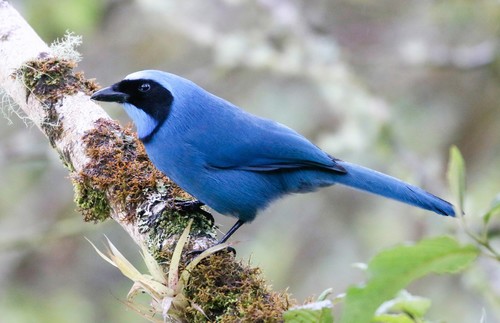
This species, Cyanolyca turcosa, commonly known as the turquoise jay, displays no sexual dimorphism. Adult turquoise jays are primarily a vibrant blue-green color that shifts appearance depending on lighting. The undersides of their wings and tail are black. They have a thick black face mask that extends to the auriculars, connecting to a thin black collar that wraps around the throat but does not continue around the nape of the neck. The forecrown is very pale, appearing almost white. Adult turquoise jays have brown irises, and all legs, feet, and bills are black. Juveniles have overall duller coloration and do not develop the thin black collar. Standard measurements for the species are as follows: total length 32 cm, wing length 137 mm, tail length 142 mm, bill length 34 mm, and tarsus length 39 mm. The primary vocalization of the turquoise jay is a short, descending whistle, most often produced in series. These whistles are loud and slightly hissy. The species also makes other calls including popping, squeaking, hissing, and static-like noises. The turquoise jay is endemic to South America, where it occurs along the western Andes Mountains from southern Colombia to northern Peru. It inhabits elevations between 2000–3000 feet, with different elevation ranges by country: it is normally found between 2600–3000 feet in Colombia, and occurs as low as 2000 feet in Ecuador. This species favors humid environments with densely tangled trees and shrubs, and can live in forests with either primary or secondary growth. It is found in tall montane evergreen forest, short elfin forest with thick vegetation, and also occupies semi-degraded habitats. The turquoise jay is classified as Least Concern on conservation assessments, as its populations across its geographic range are relatively stable, and it is considered common within its range.