About Cyanolyca cucullata (Ridgway, 1885)
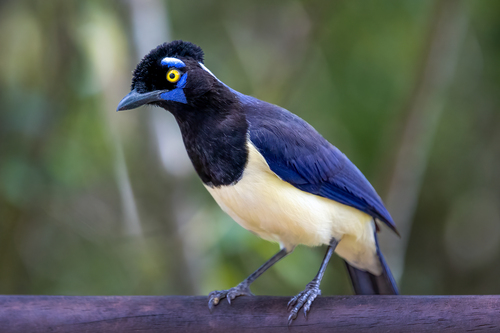
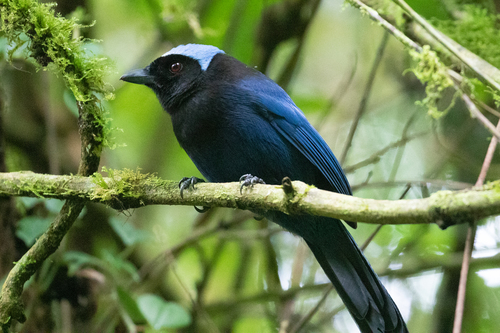
The azure-hooded jay, Cyanolyca cucullata, measures 28 to 30 cm (11 to 12 inches) in length and typically weighs 100 g (3.52 ounces). Its large body size supports the extensive flying this species engages in. Adult azure-hooded jays are primarily dark blue, with black coloring on the head and upper chest. The back of the crown and nape (the back of the neck) are sky blue with a white border. This species has black legs and bill, and dark red eyes. Males and females look nearly identical. Juveniles have duller plumage than adults, and their sky blue hood lacks the white border. This jay’s calls have several distinct forms. Its most commonly described call is a loud, bright eihnk-eihnk, usually repeated four to five times. It also produces a nasal ehr-ehn or eh'enk noise repeated twice, as well as a low, gruff, hard cheh-r call. Its alarm calls and calls used to maintain flock contact are characterized as a reek! sound, which is nasal, querulous, and has an upward or double inflection. This species is found in southeastern Mexico, Guatemala, Honduras, Costa Rica, and western Panama. It inhabits humid evergreen forests, which are sometimes mixed with pine trees. It is most often found at forest edges, occupying the middle and upper levels of the tree canopy. It only occurs in areas with uninterrupted cloud forest. As a corvid, the azure-hooded jay regularly joins mixed-species foraging flocks alongside other bird species such as unicolored jays and emerald toucanets. It also travels in conspecific groups of 2 to 10 other azure-hooded jays. This species is skulking and secretive, and rarely enters open areas. Because of this elusive behavior, it is very hard to observe in the wild, and little is known about its full ecology. Mated pairs preen one another: during this interaction, one bird bends over in front of the other, which tugs at its throat feathers. The crown feathers of the preening bird often move quickly, and this movement is thought to help the other bird assess the mate’s condition. Like other jay species, the azure-hooded jay is likely very intelligent. Related jay species are documented to use ants to clean their feathers, store seeds and nuts for later use, and hold food with their toes, but these behaviors have not yet been observed in this species due to its secretive nature. Its bright plumage makes it easy for predators to locate, and it gives a warning alarm call when it feels threatened. Azure-hooded jays typically build their nests 5 to 7 m (16.4 to 23 feet) above the ground, positioned next to a tree trunk. The first nest of this species studied had a coarse base made of twigs 2 to 3 mm (0.08 to 0.12 inches) long. This nest had an internal width of 11 cm (4.3 inches), an overall total width of 19 to 33 cm (7.4 to 13 inches) that varied with the length of its exterior twigs, and a depth of 5 cm (2 inches). The nest’s interior is constructed from woven thin fibrils and small twigs, and no feathers or other softening materials are used in its construction. Besides building its own nests, this jay will reuse old abandoned nests built by other bird species. Females normally lay 3 to 4 eggs per clutch. Young are raised in the nest between April and June, and they take at least 20 days to fledge. Both parents care for the young and feed them a range of insects, including katydids. Fledged juveniles remain close to their parents after leaving the nest.