About Cyanocorax violaceus Du Bus de Gisignies, 1847
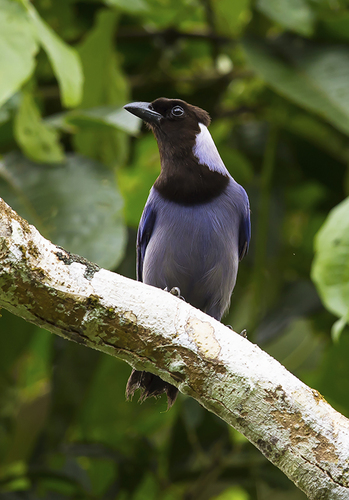
Cyanocorax violaceus, commonly called the violaceous jay, measures 33 to 37 cm (13 to 15 in) in length and weighs approximately 260 g (9.2 oz). Males and females have similar plumage patterns. For adult males of the nominate subspecies, the forecrown is blackish; the crown, sides of the head, and sides of the neck are blackish or dark sepia. The nape is pale bluish white, fading to pale blue at its base. The upper back is pale violaceous blue, while the rest of the upperparts are a darker violaceous blue. Primaries are blackish with violaceous blue coloring on the outer edges. The tail is indigo-blue. The throat and upper breast match the blackish or dark sepia coloring of the head sides, and the rest of the underparts are violaceous blue. The undersides of the wings and tail have a blackish tinge. Adult females match males in all features except their underparts have a grayish tinge. Subspecies C. v. pallidus shares the same plumage pattern as the nominate subspecies, but is noticeably paler across its entire body. Juvenile violaceous jays are overall slightly grayer than adults. Both subspecies have a dark brown iris, black bill, and black legs and feet. The violaceous jay is primarily native to the western Amazon Basin, and has two recognized subspecies. C. v. pallidus is the more northerly subspecies and has a much smaller range than the nominate subspecies, occurring only in northern and northeastern Anzoátegui state in northern Venezuela. The nominate subspecies occurs in Venezuela from southern Anzoátegui south through Amazonas, and is also found along the eastern side of the Andes from Portuguesa south to Táchira. Its range extends south through western Brazil, the eastern half of Colombia, eastern Ecuador, and eastern Peru, reaching into northern Bolivia. The eastern edge of its range in Brazil follows a rough line from Roraima south to western Mato Grosso. While some sources list Guyana as part of the species' range, the South American Classification Committee has no documented records of the species there and considers its presence in Guyana unconfirmed. The violaceous jay lives in a variety of forested habitats, including both primary and secondary forest. It is typically more abundant along watercourses. In Brazil, Ecuador, and Peru, it prefers várzea forest. Elevation limits for the species vary by region: it occurs up to 400 m (1,300 ft) in Venezuela, up to 1,000 m (3,300 ft) in Brazil, below 1,200 m (3,900 ft) in Colombia, mostly below 500 m (1,600 ft) in Ecuador, and mostly below 900 m (3,000 ft) in Peru, with local populations reaching as high as 1,400 m (4,600 ft).