About Cyanocorax mystacalis (Sparre, 1835)
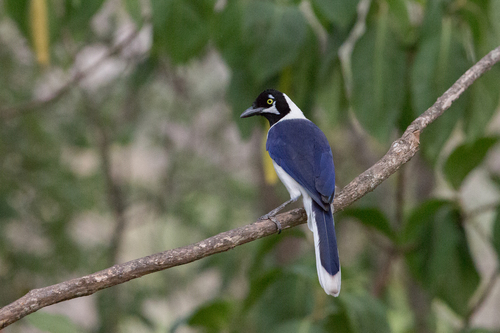
The white-tailed jay, scientifically named Cyanocorax mystacalis, has an overall white and bluish body with a black head. Its face is mostly black, marked by a small white spot above the eye, a small white moustachial stripe, and a somewhat larger white spot on the cheek. It has a white nape and white belly. The back and wings are greyish-blue, and this color extends down the top of the tail. The rectrices, tail tip, and underside of the tail are all white. It has bright yellow irises, and there are no visible visual differences between males and females. Juveniles have brown irises, and lack both the white spot above the eye and the moustachial stripe. These juvenile traits persist until their first moult. The white-tailed jay is approximately 33 cm (13 in) long. Measurements from one recorded individual include a 146 mm (5.7 in) wing length, 147 mm (5.8 in) tail length, 40 mm (1.6 in) tarsi length, and 40 mm (1.6 in) beak length. The only available weight measurements are from a single pair: the male weighed 160 g (5.6 oz) and the female weighed 149 g (5.3 oz). Little is known about the vocalizations of the white-tailed jay. Its most common call is described as "cha-cha-cha-cha", which varies in pitch across the call, and this call is thought to be used for social interaction. It also produces a high-pitched "clewp-clewp" call. The white-tailed jay has fewer vocalizations than other species in its genus, which is likely a result of its preferred open habitat, where visual communication is more useful. Within its native range, the white-tailed jay is distinct, with no other visually similar species present. It is visually very similar to the tufted jay, but the two species do not have overlapping ranges. Additionally, compared to the tufted jay, the white-tailed jay lacks a crest, has white coloration on its outer wings, and has less white on its tail. The white-tailed jay is a non-migratory species. It is distributed from northwestern Peru to southwestern Ecuador. In Ecuador, its range extends north to the province of Guayas, and runs south through El Oro and Loja. In Peru, it can be found as far south as La Libertad. It inhabits multiple types of semi-humid, semi-open woodlands across its range, including mesquite woodlands and cactus steppe. Within these habitats, it prefers to stay near thick patches of vegetation located close to rivers and streams. In some parts of Ecuador, it can be observed in cloud forests at higher elevations. It occurs at elevations ranging from sea level up to 1,200 m (3,900 ft).