About Cyanocorax dickeyi R.T.Moore, 1935
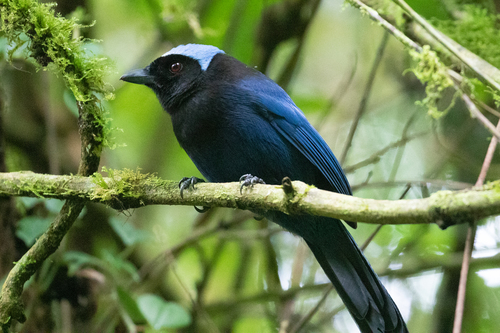
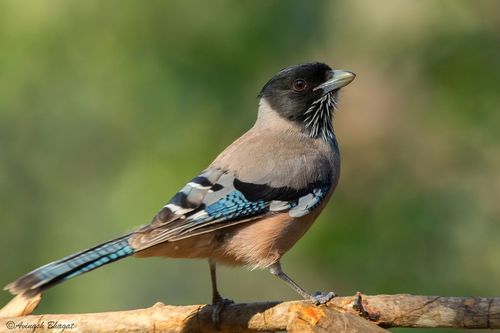
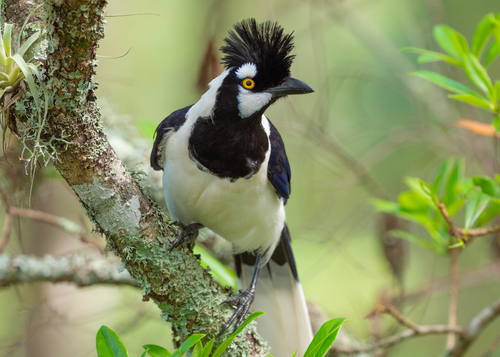
The tufted jay (Cyanocorax dickeyi R.T.Moore, 1935) is a distinctive bird within its range. It has a crest of black feathers on its head, which fades to dark blue at the crest's base. Most of its face is black to dark blue, with white spots above the eyes and white cheeks. It has a white nape and white belly. Its back and wings are purplish blue; this colour extends partway down the tail, transitioning to white about halfway along the tail's length. Both the beak and legs are black, and the species has bright yellow irises. Immature tufted jays have shorter crests, lack the white spot above the eyes, have bright blue cheeks and brown irises. This immature plumage is kept until the moult that occurs during the bird's second year. The base of an immature bird's beak is flesh-coloured, but this fades to black a few months after hatching. There is no difference in plumage or colouration between adult male and female tufted jays. The flight of the tufted jay is described as "buoyant", and the bird constantly flaps its wings while flying. The average lifespan of the tufted jay is not currently known. The tufted jay is a large jay, measuring between 35.5–38 cm (14.0–15.0 in) in total length, with males being slightly larger than females. A 1935 study recorded that males had an average wing length of 180.4 mm (7.10 in), an average tail length of 171.3 mm (6.74 in), an average beak length of 23.5 mm (0.93 in), and an average tarsus length of 45.3 mm (1.78 in). For females, the study recorded an average wing length of 177.1 mm (6.97 in), an average tail length of 164.2 mm (6.46 in), an average beak length of 23.2 mm (0.91 in), and an average tarsus length of 45.9 mm (1.81 in). The average weight of the tufted jay is 181 g (6.4 oz), and it is unknown if this average differs between sexes. The tufted jay is somewhat visually similar to the black-throated magpie-jay, but the black-throated magpie-jay is bluer, has a larger crest, a significantly longer tail, and overall brighter colouration than the tufted jay. It is also similar to the white-tailed jay, though the two species do not have overlapping ranges. Compared to the white-tailed jay, the tufted jay has a larger crest, no white on its outer wings, and more white on its tail. The tufted jay is endemic to Mexico, and is only found in a limited range within the Sierra Madre Occidental, covering an area roughly 193 km × 32 km (120 mi × 20 mi) in size. Within this mountain range, it occurs in eastern Sinaloa, western Durango, and northern Nayarit. This species is most often found at elevations between 1,500–2,000 m (4,900–6,600 ft), but has been recorded as low as 1,200 m (3,900 ft) and as high as 2,500 m (8,200 ft). The tufted jay lives in forests across its range. During the non-breeding season, it is more common in higher elevation pine-oak forests. In the breeding season, it is commonly found in ravines near water sources. It can sometimes be found at higher elevations extending onto the Mexican Plateau, or in areas that have been logged. Tufted jays are almost always found near tree tops and within the forest canopy, and are rarely seen on the ground.