About Cyanocorax cristatellus (Temminck, 1823)
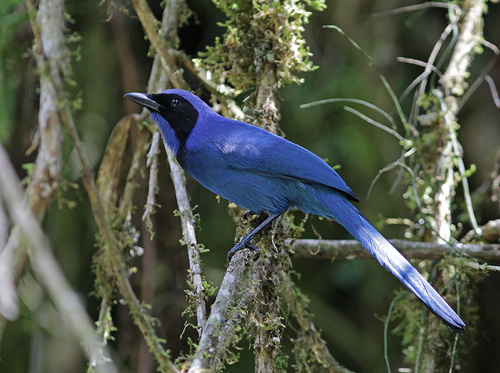
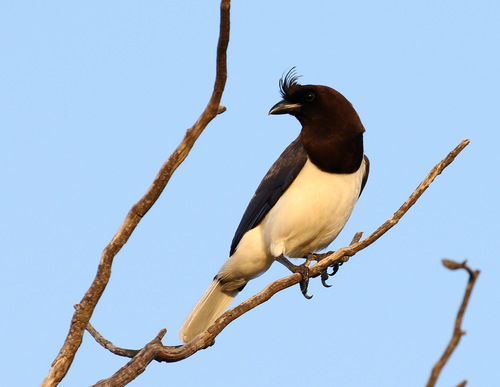
The curl-crested jay, Cyanocorax cristatellus, is a jay species native to South America. This large New World jay measures 35 cm (14 inches) in total length. It has a mostly dark blue back, an almost black head and neck, and bright white chest and underparts. It features a distinct curled crest that rises just behind its beak; on average, the crest is larger in males, though the sexes are generally very similar in appearance. Its call is a loud, drawn-out graa sound, often repeated 8 to 10 times in a sequence. Its vocalization is similar to that of a crow. This species is native to the cerrados of central and southern Brazil and the caatinga of northeastern Brazil. In the southeastern Amazon Basin, its range extends into upstream headwater regions adjacent to northwestern cerrado. On the western edge of its range, it occurs in the extreme headwaters of the west-flowing Guaporé River along the Brazil-Bolivia border. For the southeastern Amazon, its range is bounded to the west by the north-flowing Tapajós River, and continues east past the Xingu River to the adjacent Araguaia-Tocantins River drainage system. Its range extends east and south through the cerrado, and it only occupies the upstream half of these river drainages. It can also be found in extreme northern Paraguay. Overall, its distribution is limited by the availability of suitable habitat, but it is not rare in areas with appropriate habitat. For example, it is the most frequently observed corvid in Serra do Cipó National Park. Curl-crested jays live in groups of 6 to 12 individuals, traveling between food sources throughout the day. Group members leave a lookout posted nearby to watch for predators. This bird is a dietary generalist that eats almost anything, including the eggs and nestlings of other birds, insects, other arthropods, and small vertebrates such as geckos. It also consumes palm nuts, and is especially fond of the seeds of the native plant Inga laurina and the fruits of the introduced umbrella tree, Heptapleurum actinophyllum. It has even been observed feeding in pequi trees (Caryocar brasiliense) during early morning, where it eats nectar, and may also eat invertebrates that visited the tree’s primarily night-blooming flowers. The IUCN does not classify the curl-crested jay as a threatened species, and the species is currently expanding its range. However, this range expansion may only be temporary, and populations may eventually disappear from areas they colonized.