About Cyanocorax beecheii (Vigors, 1829)
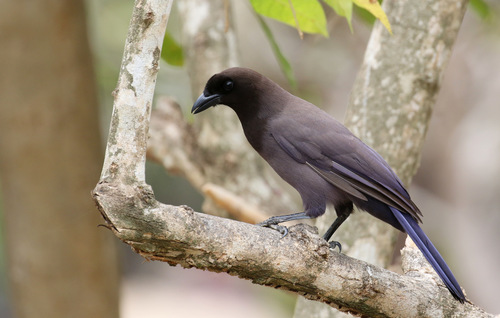
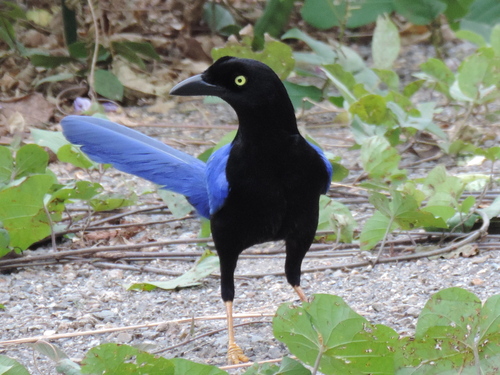
The purplish-backed jay, Cyanocorax beecheii, is a purple and black bird with a strong bill and long tail. Its total length ranges from 35 to 41 cm (14 to 16 in), and males are typically larger than females. The bird's head, neck, upper mantle, and underparts are black, with a small ruffled erectile crest located on the forehead. The underside of the wings and the tail are also blackish, while the rest of the plumage is purplish-blue, with the brightest coloration on the lower mantle and rump. It has a black bill, yellow irises, and yellow legs. Ecologically, this jay lives in small social groups made up of an adult pair and up to three young from the previous year. Groups move through the forest, using different foraging strategies to get the invertebrates and small vertebrates that form part of their diet: some insects are caught in mid-air, others are plucked from leaves, grubs are extracted by probing bark, and other prey is found by foraging through plant litter. The species is omnivorous, and birds sometimes leave the forest to feed in orchards, grain fields, rubbish dumps, and along road verges. These social groups are territorial, occupying home ranges of 25 to 43 hectares (62 to 106 acres) that they defend against neighboring groups. They also mob and drive away predators. Purplish-backed jays pair for life; pair bonding behaviors include various vocal displays, mutual preening, and passing food between partners. Even when a group contains more than one pair, only the dominant pair normally breeds in a given year. Other group members assist the female in building the nest, which is an untidy platform made of twigs. A clutch of approximately five eggs is laid in early May. The female incubates the eggs for around 19 days, and is fed by the male and sometimes other group members. Newly hatched chicks are fed by both parents and other group members, and fledge after about 24 days. Juvenile males stay with their natal group for around a year before dispersing, while females may stay with the group indefinitely.