About Cyanocitta stelleri (Gmelin, 1788)
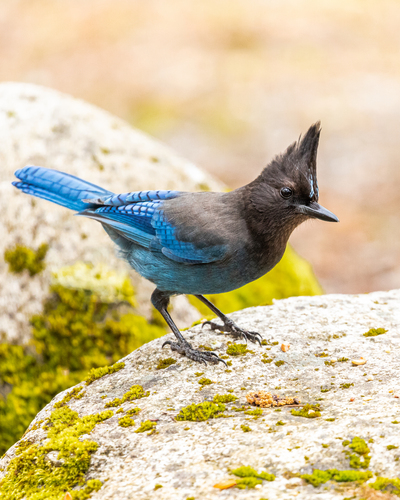
Steller's jay (Cyanocitta stelleri) measures about 30–34 cm (12–13 in) in length and weighs approximately 100–140 g (3.5–4.9 oz). The species shows extensive regional variation across its range: northern populations have blackish-brown heads, which become progressively bluer in populations farther south. Compared to the blue jay, Steller's jay has a more slender bill, longer legs, is somewhat larger overall, and northern populations have a much more prominent crest. The color of the head ranges from blackish-brown to black to dark blue, depending on the subspecies, with lighter streaks on the forehead. This dark color transitions from the shoulders and lower breast to silvery blue. The primary wing feathers and tail are a rich blue with darker barring. Populations in the eastern part of the species' range along the Great Divide have white markings on the head, especially above the eyes; populations further west have light blue markings, while populations in the far west along the Pacific Coast have small, very faint, or no white or light markings at all. Steller's jay lives across most forested areas of western North America, reaching as far east as the eastern foothills of the Rocky Mountains, extending from southern Alaska in the north to northern Nicaragua in the south. In this region, it completely replaces the blue jay that is common across the rest of the continent. Population density is lower in the central Rocky Mountain region (including Montana, Idaho, Wyoming and eastern Utah) as well as desert or scrubland areas of the Great Basin (for example Nevada, western Utah, southern Arizona and parts of California). Hybridization with the blue jay has been reported in the eastern foothills of the Rocky Mountains, particularly in Colorado. In Mexico, the species is found through the interior highlands of northwestern Mexico, with additional patchy populations across other parts of the country. It also occurs in south-central Guatemala, northern El Salvador, Honduras and Nicaragua. At the northern end of its range, Steller's jay appears to be spreading from coastal Southeast Alaska across the Coast Mountains into southern Yukon Territory. Although Steller's jay primarily inhabits coniferous forests, it can also be found in other forest types. It occurs from low to moderate elevations, and rarely reaches as high as the tree line. Steller's jays are common in residential and agricultural areas located near forests.