About Cyanocitta cristata (Linnaeus, 1758)
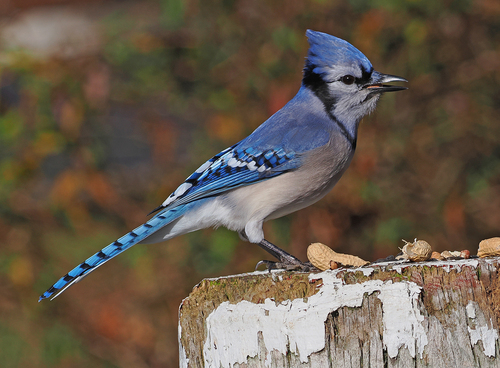
Blue jay, with the scientific name Cyanocitta cristata (Linnaeus, 1758), measures 22–30 cm (9–12 in) from bill to tail, weighs 70–100 g (2.5–3.5 oz), and has a wingspan of 34–43 cm (13–17 in). Consistent with Bergmann's rule, jays from Connecticut average 92.4 g (3.26 oz) in weight, while jays from warmer southern Florida average 73.7 g (2.60 oz). Blue jays have a pronounced feather crest on their head that can be raised or lowered according to the bird's mood. When the bird is excited or aggressive, the crest is fully raised. When frightened, the crest bristles outwards in a brush-like shape. When the bird feeds among other jays or rests, the crest is flattened against the head. The crest, back, wings, and tail are colored lavender-blue to mid-blue, and the bird's face is white. The underside is off-white, and the neck has a black collar that extends to the sides of the head. The primary wing feathers and tail are strongly barred with black, sky-blue, and white. The bill, legs, and eyes are all black. Males and females are almost identical in appearance, but males are slightly larger. The black plumage on the nape, face, and throat varies widely between individuals, and this variation is believed to help individuals recognize one another. Like most other blue-colored birds, the blue jay's blue coloration does not come from pigments. It is instead the result of light interference caused by the internal structure of its feathers. If a blue feather is crushed, the blue disappears because this structural arrangement is destroyed. The actual pigment present in the blue jay's feathers is melanin, a type of structural coloration. The blue jay's range extends from southern Canada through the eastern and central United States, south to Florida and northeastern Texas. The western edge of its range stops where the arid pine forest and scrub habitat of the closely related Steller's jay (C. stelleri) begins, which is generally the eastern foothills of the Rocky Mountains. In recent times, the blue jay's range has expanded northwest, so it is now a rare but regularly sighted winter visitor along the northern U.S. and southern Canadian Pacific Coast. Now that the ranges of blue jays and Steller's jays overlap, C. cristata may sometimes hybridize with Steller's jays. In 2023, a hybrid between a male blue jay and a female green jay (Cyanocorax luxuosus) was found and photographed near San Antonio, Texas, and confirmed to be a hybrid in 2025. Just as with the overlapping ranges of blue jays and Steller's jays, the ranges of blue jays and green jays now overlap, allowing the birds to interbreed and produce hybrid offspring. Over the past century, increased tree coverage across the Great Plains caused by fire suppression and tree planting helped the blue jay expand its range westward, alongside many other bird species. Between 1966 and 2015, the blue jay population declined along the Atlantic coast, but saw an annual population increase of greater than 1.5% across the northern part of its range, including Labrador, Nova Scotia, southern Quebec, and southern Manitoba. The northernmost subspecies C. c. bromia is migratory when necessary. It may move several hundred kilometers south from the northernmost parts of its range. Thousands of blue jays have been observed migrating in flocks along the Great Lakes and Atlantic coasts. They migrate during the daytime in loose flocks ranging from 5 to 250 birds. Much about blue jay migratory behavior remains unknown. Some blue jays are present throughout winter in all parts of their range. Young jays may be more likely to migrate than adults, but many adults also migrate. Some individual blue jays migrate south one year, stay north the next winter, and migrate south again the following year. To date, no research has clearly determined why blue jays migrate when they do. It is likely linked to weather conditions and the abundance of winter food sources, which influence whether northern birds move south. Blue jays live in a variety of habitats across their large range, from Florida's pine woods to the spruce-fir forests of northern Ontario. They are less abundant in dense forests, and prefer mixed woodlands with oaks and beeches. They have adapted very well to human activity, and occur in parks and residential areas. They can also adapt relatively easily to widespread deforestation if human activity creates other resources for the jays to use. Blue jay mating season begins in mid-March, peaks from mid-April to May, and continues into July. Blue jays will use any suitable tree or large bush for nesting, though they prefer evergreens. They prefer to build nests 3 to 10 m (10 to 33 ft) high in trees. Nests are cup-shaped, made from twigs, small roots, bark strips, moss, other plant material, cloth, paper, and feathers, with occasional mud added to the cup. Blue jays are not very selective about nesting locations. If no better site is available, for example in heavily deforested areas, they will even use spots like the large rural mailboxes common in the United States. They also take over nests of other mid-sized songbirds when these nests are in suitable locations; American robin nests are commonly used by blue jays, for example. Blue jays typically form lifelong monogamous pair bonds. Both sexes build the nest and raise the young, though only the female broods the chicks. The male feeds the female while she broods the eggs. Blue jays usually lay between 3 and 6 eggs, averaging 4 or 5, which are incubated over 16–18 days. Young blue jays usually fledge between 17 and 21 days after hatching. After juveniles fledge, the family travels and forages together until early fall, when the young birds disperse to avoid competition for winter food. Blue jays reach sexual maturity at one year of age. The oldest known recorded wild banded blue jay was at least 26 years and 11 months old when it was found dead after being caught in fishing gear. It had been banded in the Newfoundland/Labrador/Saint-Pierre et Miquelon area in 1989, and was found there in 2016. Another wild blue jay was recorded to be around 17 and a half years old. A more common lifespan for wild blue jays that survive to adulthood is around 7 years. Beyond predation and occasional collisions with human-made objects, a common cause of blue jay mortality in recent decades has been West Nile virus, which corvids as a whole seem especially susceptible to. However, despite several major local population declines, the overall blue jay population does not appear to have been depleted by the disease.