About Cyanoboletus pulverulentus (Opat.) Gelardi, Vizzini & Simonini
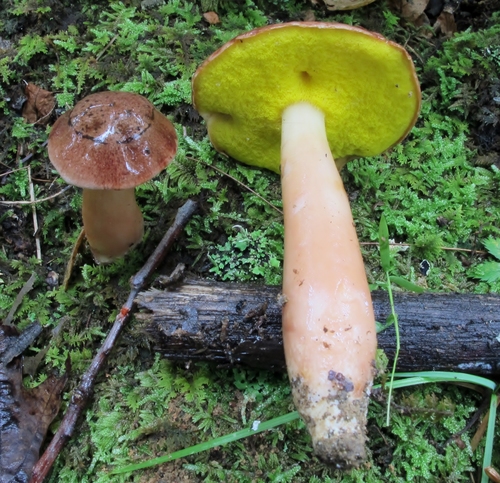
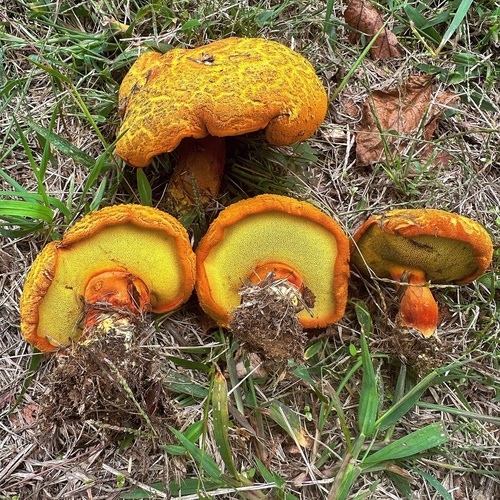
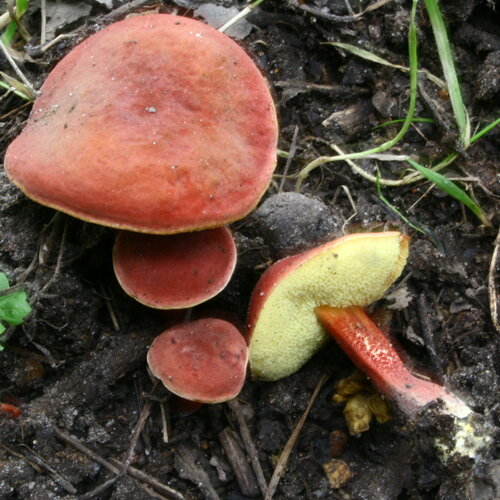
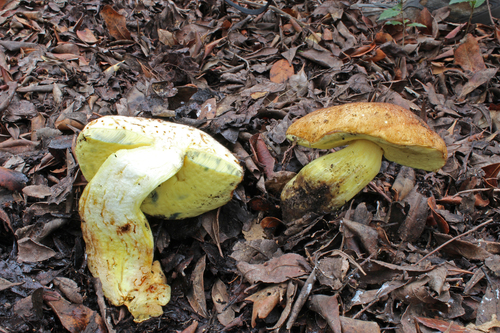
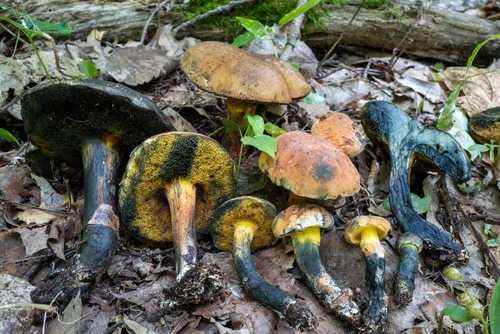
This fungus has the scientific name Cyanoboletus pulverulentus (Opat.) Gelardi, Vizzini & Simonini. The cap is convex when young, becoming flat with age. It is dark reddish-brown when young, lightening in colour as it ages, and can reach up to 10 cm (4 inches) in diameter. The cap cuticle is made of a tissue layer of undifferentiated hyphae that are 3–7 μm wide. The stalk is long and slender, bright yellow to orange yellow at the top, and reddish-brown at the base. The flesh is yellow, has a mild taste, and immediately turns blackish-blue when handled. The spore-bearing basidia cells measure 22–35 by 6–9 μm. The spores are smooth, fusoid (fuse-shaped) to elliptical, and measure 11–15 by 4–6 μm. The spore print is olive brown. Cyanoboletus pulverulentus is an ectomycorrhizal species that forms associations with coniferous and deciduous trees, particularly oak. Its fruit bodies grow on the ground in woodland, usually appearing singly. This bolete is widely distributed; it has been reported from northern Asia, Europe, North Africa, Central and northern South America, and eastern North America, where it fruits from July to September. Reports of this species from western North America may actually refer to the similar species Cyanoboletus rainsii, which stains greenish-black instead of bluish-black.