About Cyaniris semiargus (von Rottemburg, 1775)
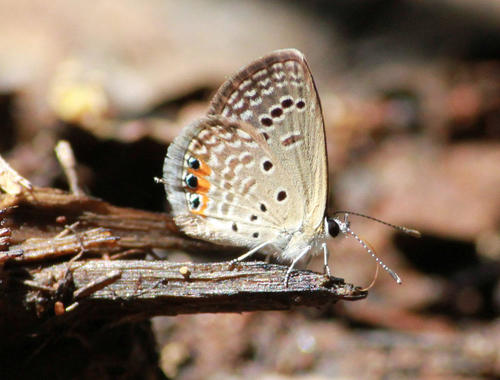
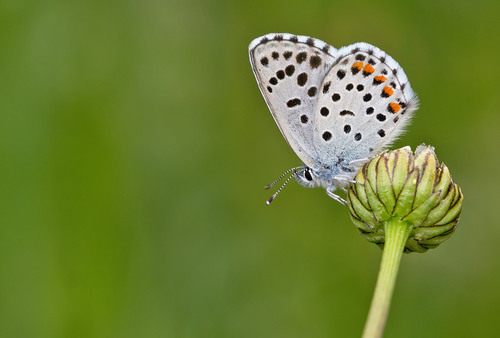
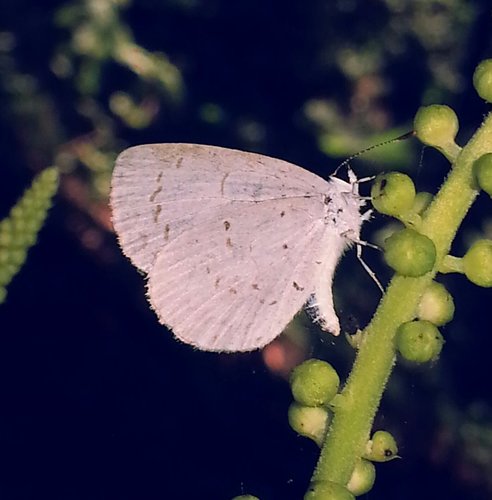
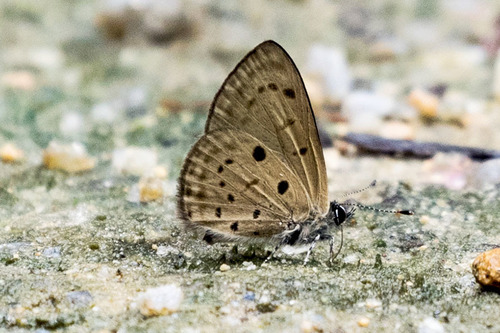
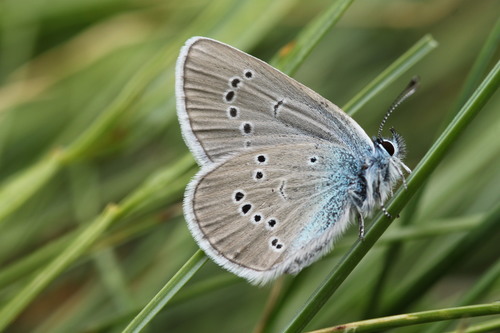
This species of butterfly is Cyaniris semiargus, commonly known as the Mazarine blue. Both males and females share a similar wingspan of 32–38 mm, though males are slightly larger than females, and the species exhibits clear sexual dimorphism. Males have deep blue wings with prominent venation, black wing borders on the upperside, and white fringes. Females have brown wings. The underside of the wings is greyish or ochre, with a series of black spots surrounded by white and blue scaling in the basal area. Neither sex has orange markings, and both have a dark violet or brown body. It is often compared to the common blue butterfly and to Cyaniris bellis from Greece, which does have orange markings. It is also quite similar to Cupido minimus; on the underside of the Mazarine blue’s hindwing, the black spot in space 6 and the two adjacent spots form an obtuse angle, while in C. minimus these spots form an acute angle. The species’ larva is yellow green with darker lines, fine hairs, and dark brown spiracles. The pupa is olive green and attaches to the butterfly’s food plant with a silk girdle. In Seitz’s description, this species is also referenced as L. semiargus Rott. (= acis Schiff., argiolus Fuessl, argianus Zett.). Males are dull but deep blue above with no gloss, a black margin, a thin dark discocellular spot, and pure white fringes. Females are black-brown above with darkened fringes. The underside is earth-grey with blue scaling at the base, a distinct discocellular spot, a row of discal ocelli, and a basal ocellus below the hindwing costa. Several aberrations and subspecies are documented: ab. spadae Hellweger lacks all ocelli; ab. caeca Fuchs has only one ocellus on the forewing; in ab. striata Wheel., the ocelli are modified into streaks; aetnaea Zett., discovered on Mount Etna, has enlarged ocelli positioned closer to the outer margin. The subspecies Cyaniris semiargus montana M.-Dur is an alpine form found in the higher Alps and mountains of South-East Europe; it is smaller than the main form, and males are bright blue above with a broader black distal border. Previously treated as a separate subspecies here, Cyaniris bellis Frr. is similar in upperside appearance to montana, but has faint yellowish red spots in the anal area of the underside hindwing. Variants of Cyaniris bellis include: impura Krul from East Russia, which has dull yellow spots along the entire outer margin, particularly on the hindwing; parnassia Stgr. from the Balkan Peninsula, which resembles impura but is larger; helena Stgr., a small form from the mountains of Southern Greece, where the reddish yellow underside spots form a continuous chain, and some spots appear on the female upperside; the more southerly antiochena Led. (C. b. antiochena) generally shows this upperside spotting in females. The larva is dull greenish yellow with a brown head, a dark dorsal line, and a dark lateral line; it feeds within the inflorescences of Anthyllis and Armeria vulgaris through July and autumn. The pupa is light olive-green, and hibernating pupae turn brown later; it is fastened by its anal end to the food plant stem. Adult butterflies fly in May and again in August; they are typically found singly but are common in most areas, flying along wide forest roads and grassy field borders. Their flight is rather clumsy and very low, with individuals usually staying very close to the ground and frequently visiting Potentilla, Ranunculus, and Trefoil. In high mountains, the species is one of the most common found on damp roadside areas. The Mazarine blue is distributed across continental Europe, extending into the Arctic Circle, Morocco, the Middle East, and east across the Palearctic to Siberia and the Russian Far East. A large native population existed in Britain in the early 19th century, but the resident population disappeared before the 20th century, with some estimates placing the local extinction as late as 1906; occasional single vagrants have been recorded in the region. In 2009, UNESCO researched the possibility of reintroducing the Mazarine blue to Britain. In recent years, the species’ numbers have declined across its European range, particularly in Scandinavia, for reasons that remain unclear. The Mazarine blue is a common species that inhabits meadows, pastures, grasslands, and flowery damp grassy areas up to 2200 m elevation. It appears to prefer areas that are not fertilized and not used for fodder production.