About Cyanerpes lucidus (P.L.Sclater & Salvin, 1859)
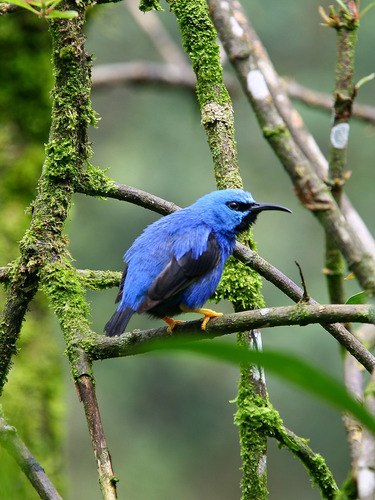
The shining honeycreeper, Cyanerpes lucidus, is a small bird species in the tanager family. It is native to the tropical New World, with a distribution ranging from southern Mexico through Central America to Panama and northwest Colombia. It is sometimes classified as conspecific with the purple honeycreeper, C. caeruleus, but the two species breed sympatrically in eastern Panama and northwest Colombia. This species occurs primarily in the forest canopy, and can also be found in forest edges and secondary growth. The female shining honeycreeper builds a shallow cup-shaped nest in a tree, and incubates a clutch of two eggs. The shining honeycreeper measures 10 cm in length, weighs 11 g, and has a long black decurved bill. Males are purple-blue with black wings, tail, and throat, and have bright yellow legs. Females have green upperparts, a greenish-blue head, a buff throat, and bluish underparts streaked with buff. Immature shining honeycreepers are similar to females, but are greener on the head and breast. The call of this honeycreeper is a thin, high-pitched seee, while the male's song is a repeated pit pit pit pit pit-pit that can continue for minutes at a time. This species is very similar to the purple honeycreeper, but male purple honeycreepers are overall slightly darker with a smaller black throat patch. Female purple honeycreepers differ from female shining honeycreepers in having buff rather than dusky lores, and lack a clear blue tinge to the head except on the malar area. The shining honeycreeper shares its range with the larger red-legged honeycreeper, and can be easily distinguished from it by the red-legged honeycreeper's red legs, and the black mantle of male red-legged honeycreepers. Shining honeycreepers usually occur in pairs or family groups. They feed on nectar, berries, and insects, mostly foraging in the canopy. This species responds readily to the call of the ferruginous pygmy owl.