About Cyanerpes cyaneus (Linnaeus, 1766)
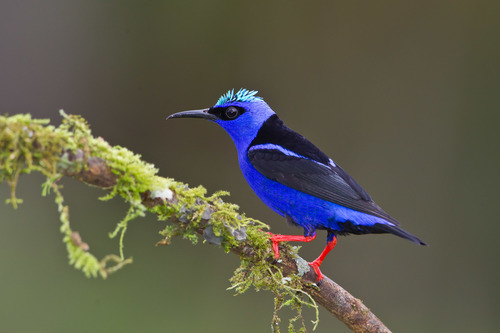
The red-legged honeycreeper, scientific name Cyanerpes cyaneus (Linnaeus, 1766), has an average length of 12.2 cm (4.8 in) and an average weight of 14 g (0.49 oz). It has a medium-long, slightly decurved black bill. Breeding-plumage adult males are violet-blue with black wings, tail, and back, and bright red legs. The crown of the male's head is turquoise, and its underwing, which is only visible during flight, is lemon yellow. After the breeding season, males moult into an eclipse plumage that is mostly greenish with black wings. Females and immature red-legged honeycreepers are mainly green, with paler, faintly streaked underparts. Female red-legged honeycreepers have red-brown legs, while young birds have brown legs. The call of this species is a thin, high-pitched tsip. Multiple subspecies of Cyanerpes cyaneus are recognized, and most differences between subspecies are slight; for example, the Tobago subspecies C. c. tobagensis is slightly larger than mainland forms of the species. The purplish honeycreeper (Chlorophanes purpurascens), a bird from Venezuela known only from its type specimen, is thought to be an intergeneric hybrid between the green honeycreeper and either the red-legged honeycreeper or the blue dacnis. This species occurs in forest edge, open woodland, and cocoa and citrus plantations. Red-legged honeycreepers are often found in small groups. They feed on insects, as well as some seeds, fruit, and nectar. They readily respond to the call of the ferruginous pygmy owl (Glaucidium brasilianum), which is easily imitated.