About Cyanerpes caeruleus (Linnaeus, 1758)
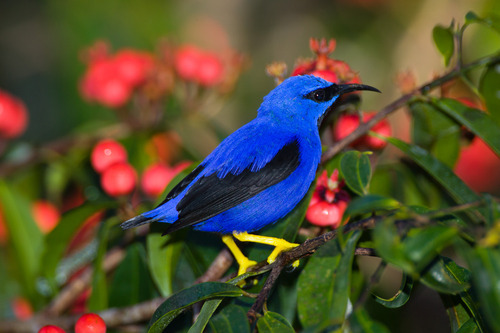
This species, commonly known as the purple honeycreeper, has a scientific name of Cyanerpes caeruleus (Linnaeus, 1758). The purple honeycreeper measures 4.5 inches (11.5 cm) long, weighs 0.42 ounces (12 g), and has a long black decurved bill. Males are purple with black wings, tail, and belly, and have bright yellow legs. Females and immature individuals have green upperparts and green-streaked yellowish-buff underparts, with a cinnamon-colored throat and a blue moustachial stripe. The Trinidadian subspecies C. c. longirostris has a longer bill than mainland forms of the species. The purple honeycreeper’s call is a thin, high-pitched zree. This species is native to northern South America. In addition to the Amazon Basin and the Guianas, a coastal population of the species occurs west of the Andes, including parts of southern Panama. Its range extends south to the extreme western Pantanal. While the purple honeycreeper is most often found in lowlands up to approximately 3,300 ft (1,000 m) above sea level, it has been observed as high as 7,500 ft (2,300 m) above sea level. It is a forest canopy species, and also occurs in cocoa and citrus plantations. At the upper end of its altitudinal range, it inhabits premontane rainforest that is typically 33–50 ft (10–15 m) tall, low-growing, and full of epiphytes and mosses; it can even be found in elfin forest and páramo. Purple honeycreepers are often found in small groups. They feed on nectar, particularly from bromeliad and similar flowers, which their bill shape is adapted for; they also eat berries and seeds from genera including Trema and Clusia, fruit including bananas and papayas, and insects. Most foraging activity occurs in the canopy. This is a bold, inquisitive species, and readily responds to the call of the ferruginous pygmy owl (Glaucidium brasilianum) by emerging from cover to search for the presumed predator and mob it. The female purple honeycreeper builds a small cup nest in a tree, and incubates a clutch of two white eggs marked with brown blotches.