About Cuscuta pacifica Costea & M.A.R.Wright
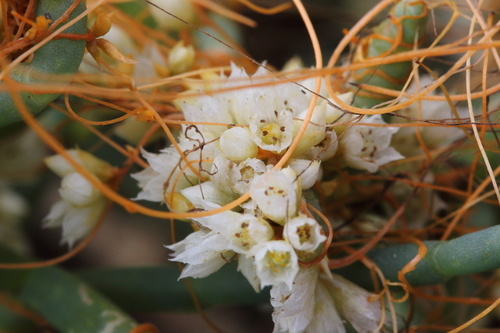
Cuscuta pacifica is a slender annual parasitic vine, with yellowish thread-like stems that wrap tightly around other plants. Like all members of the genus Cuscuta, it is a parasitic plant. Its leaves are reduced to tiny scales, and it grows no roots; it instead taps nutrients from host plants using specialized structures called haustoria. This species is commonly known as salt marsh dodder. Its flowers have bell-shaped, white glandular corollas with five-pointed triangular lobes. It typically parasitizes plants of the genus Salicornia, but it can also be found growing on other species including Jaumea carnosa and Grindelia stricta. Recent research has indicated that waterfowl may be involved in dispersing this species' seeds, which has already been confirmed for the related species Cuscuta campestris. Cuscuta pacifica is native to the coast of western North America, ranging from British Columbia in the north to Baja California in the south. It is a halophyte that grows in coastal salt marsh habitats, such as the San Francisco Bay.