About Cuscuta europaea L.
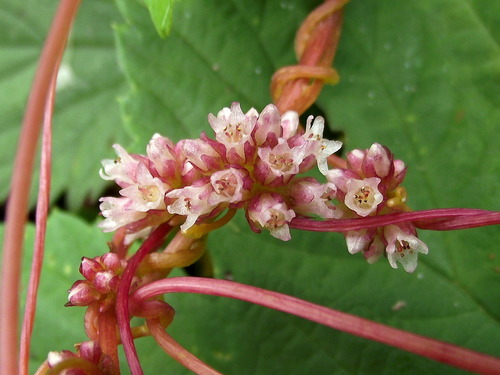
Cuscuta europaea L. has long, thin yellowish or reddish stems. Its inflorescences form laterally along stems, with flowers arranged in compact glomerules that hold few to many flowers. Flower pedicels grow up to 1.5 millimetres long. The 1.5 mm cup-shaped calyx has 4 or 5 triangular-ovate sepals. The 2.5–3 millimetre corolla is pink, with 4 or sometimes 5 lobes. The corolla persists after anthesis and is often reflexed. Stamens are inserted below the corolla sinuses, and their filaments are longer than the anthers. The anthers are ovate-circular with very thin scales. The ovary is subglobose with 2 styles, and the stigmas are divergent or curved. The rounded seed capsule is 3 mm wide, capped by the withered corolla. Each capsule usually holds 4 pale brown, elliptic seeds that are 1 mm long. Cuscuta europaea is distributed across Europe, western Asia, and northern Africa, and is also found in Japan and Algiers. In India and Pakistan, it occurs in the Himalayas from Kashmir to Sikkim, growing up to an altitude of 3,600 metres (11,800 ft).