About Cuscuta epithymum (L.) L.
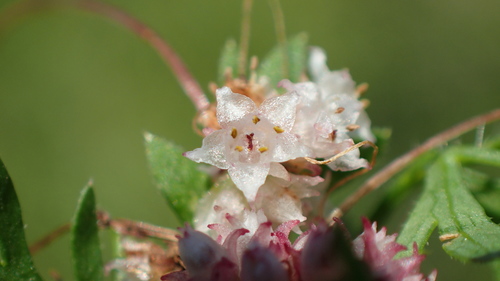
Cuscuta epithymum (L.) L. is a rootless holoparasitic plant. It produces thin, 0.25–0.40 mm wide, hairless, thread-like (filiform) stems that can be pink, red, yellow or purple. Its leaves are very small and grow as scale-like structures along the stems. The species attaches to its host plant using specialized structures called haustoria. Its white or pink flowers grow in clusters of 7 to 25 directly from the stems. Each flower has five petals and five sepals; the petals are fused to form a cup-shaped corolla that is longer than the sepals. After flowering, it produces small round fruits topped with the remains of withered petals. Each fruit holds up to four seeds, and each seed is approximately 1 mm long. Six distinct varieties of Cuscuta epithymum have been formally described, distinguished by differences in the number, arrangement, and structure of their flowers.
As a native species, Cuscuta epithymum ranges from Macaronesia in the west, across most of Europe, and extends eastward to Xinjiang in Northwest China. It is also native to parts of western North Africa.
Cuscuta epithymum is generally considered an annual plant that grows from seeds, which germinate only when conditions are suitable. Its seeds exhibit both physiological and physical dormancy, which lets them persist in soil for multiple years. New shoots must locate a host plant quickly, because the seed only contains a very small amount of stored nutrients. Once a shoot finds a host, it rapidly grows over the host and twists counter-clockwise around the host's stems. It then tightens its coils and produces haustoria that penetrate the host's epidermis to reach the underlying xylem tissue, which lets the parasite extract both water and nutrients from the host. Some parasite stems are tightly coiled around the host, while other stems remain loosely coiled to let them search for other parts of the same host or an entirely new host. After the plant matures and flowers, it is pollinated either by insects or through self-pollination when insect pollination does not occur. Mature seeds are dropped onto the ground below the host plant, where they remain dormant until conditions are right for germination. When growing on some perennial host plants, Cuscuta epithymum forms small galls that hold parasitic tissue able to survive through the winter; new shoots grow from these galls the following spring.
This dodder species is widely used in traditional medicine to treat a wide range of health conditions. It has been used as a purgative, and to treat insanity, depression, leprosy, diabetes, jaundice, liver disorders, spleen disorders, urinary tract disorders, vision problems, syphilis, and rheumatism. Evidence suggests it can cause hepatotoxicity when used in high doses over long periods of time.