About Curio radicans (L.) P.V.Heath
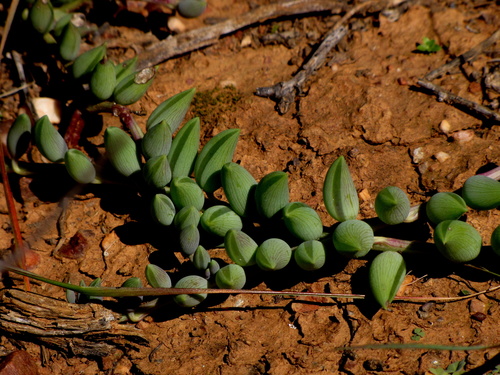
Curio radicans has a prostrate growth habit, with mat-forming stems that grow 15–30 cm long. Its succulent leaves grow in an alternating arrangement along the stems. Each leaf is 2–3 cm long, marked with two translucent lines on either side, and shaped like a tapering curved cylinder that resembles a banana. Like other species in the genus Curio, its inflorescences are pseudanthia: clusters of many small flowers growing on a shared receptacle. These pseudanthia are small, cinnamon-scented, and colored white or off-white. They typically bloom in late winter or early spring, but may sometimes bloom multiple times throughout the year. Curio radicans is native to South Africa, Namibia, and Lesotho. In arid desert areas of South Africa, including the Karroid central region, the dominant vegetation is made up of xerophytic dwarf shrubs and succulents, including many members of the tribe Senecioneae. In these very low-moisture areas, the grasslands common to other regions of Africa are replaced by habitats where grass is subdominant to these drought-tolerant plants. These plants are often spaced far apart, with wide stretches of sandy or rocky ground between them. Curio radicans is frost-tender, and cannot survive freezing temperatures below 0 °C (32 °F). This restricts the species to areas where annual temperatures do not drop below this threshold. Like most members of the Curio genus, C. radicans is relatively hardy and easy to grow, which makes it a popular ornamental plant. In warm climates, it can be grown as a groundcover; in cooler regions, it is grown as a potted houseplant in pots and hanging baskets. This species is cultivated more for the color, shape, and texture of its foliage than for its blooms, which are small, white, and not very showy.