About Curetis bulis Westwood
Scientific name: Curetis bulis Westwood
Male: Upperside forewing: Velvety black, with an elongated broad medial dark orange-red patch. This patch extends outwards from the base to around three-fourths of the wing's length, and fills the area from vein 1 to the middle of the cell. In some specimens, it spreads diffusely below vein 1 near the base, but this area is shaded with dusky black. The outer margin of this red patch is unevenly rounded.
Upperside hindwing: Brownish black, with a large orange-red spot that runs from above vein 3 to near the apex. The spot extends inward into the cell to near the base of the wing, and is diffusely extended posteriorly below vein 3. The cell area is heavily overlaid with dusky-black scaling, and the posterior region is shaded with long brown hairs that take on a golden tint in certain lighting. A prominent broad streak, darker than the wing's ground color, runs above the cell from the wing base to the inner margin of the orange spot. The abdominal fold is pale pinkish brown.
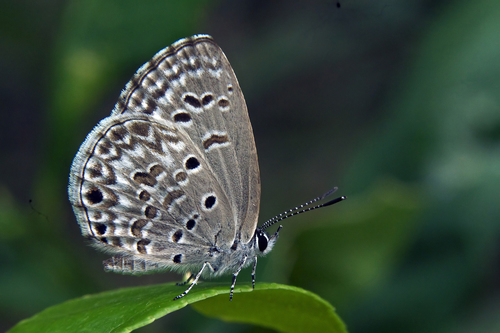
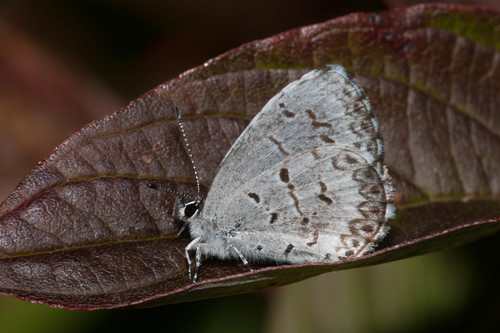
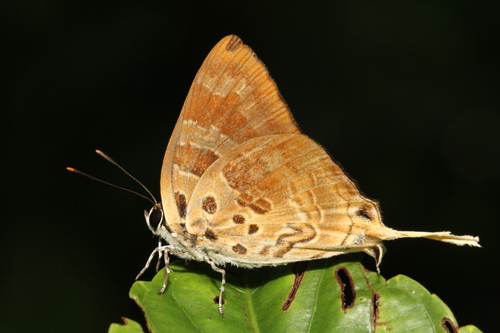
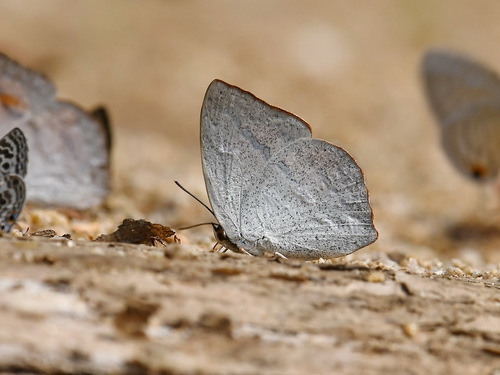
Underside: Silvery white with sparsely scattered tiny black dots. On the forewing, there is a discal series and an inner subterminal series of very faint, somewhat lunular black markings, which form broken bands that converge toward the anterior. These bands continue across the hindwing to the tornus. Beyond these bands, an outer subterminal series of tiny black dots occurs on both the forewings and hindwings, and this series is very indistinct in most specimens. Antennae, head, thorax, and abdomen are dark brown; the sides of the abdomen are golden brown. On the underside, the palpi, thorax, and abdomen are white.
Female: Upperside: More or less matches the male, but the dark orange-red medial patches are replaced with white and are much larger. On the forewing, this white patch extends above the cell; the discocellulars that close the cell are marked prominently by a black tooth, and the patch reaches the dorsal margin posteriorly. On the hindwing, the white patch is very large, and very diffuse in some specimens. Both the forewings and hindwings are shaded with dusky scales at the base, and in many specimens the underside markings are clearly visible through transparency. The broad black streak above the cell on the hindwing is present in some specimens and absent in others. Underside: Ground color and markings match the male, but are much more prominent.