About Curetis acuta Moore, 1877
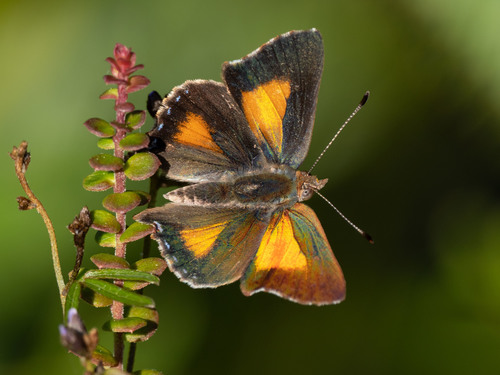
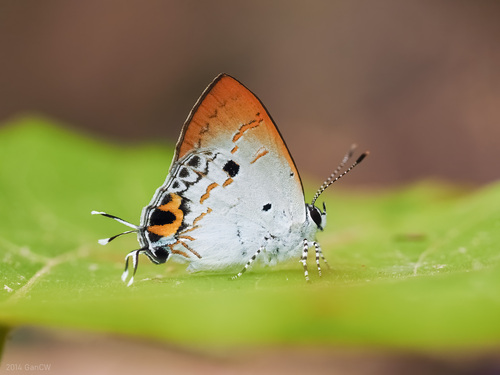
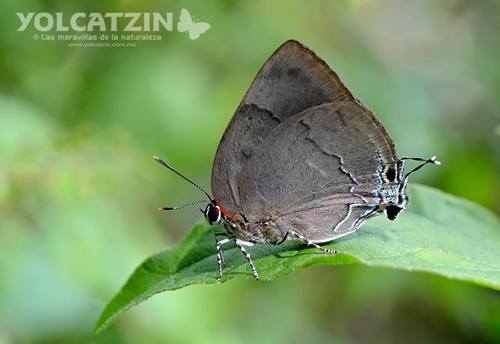
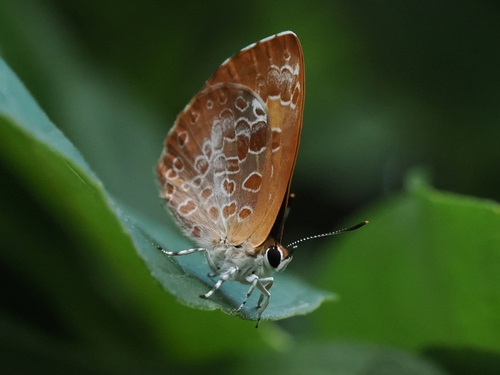
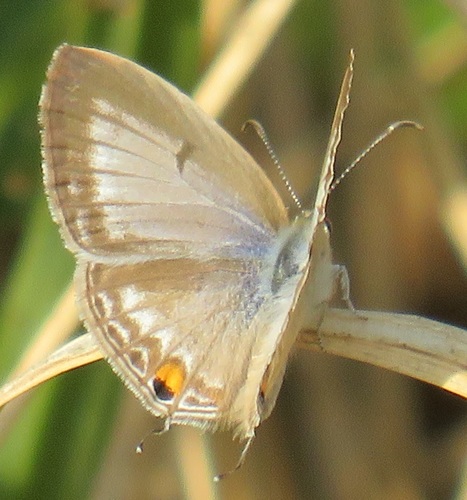
This description covers Curetis acuta Moore, 1877. On the upperside of the male forewing, the margin is broadly black, broadest at the apex and hinder angle. The inner edge of the black margin is almost evenly rounded, and the black marginal band extends inward along the hinder margin, narrowing rapidly toward the wing base and ending around the middle of the margin. A black spot at the end of the cell connects to the costal black band, and there are greenish-brown speckles at the base of the wing. The forewing apex is very sharp; the outer margin is somewhat concave just below the apex, the hinder angle is triangular, and the hinder margin is nearly as long as the costa, making the outer margin roughly upright, though slightly wavy. For the male hindwing, greenish-brown speckles are present at the base and across a broad portion of the abdominal area. A black streak runs along the upperside of the sub-costal nervure from the wing base to the middle of the wing, where it thickens. The costal space is narrow and nearly white, and there is an outer marginal black band that starts narrowly on the costa before the apex, widens very gradually around the apex, widens suddenly at the middle, then becomes diffuse toward the rear of the wing. From the apex to the middle of the wing, the apex and outer margin are evenly rounded; from the middle to the much elongated, sharp anal angle, there is a series of slight scallops along an oblique, relatively straight edge. The abdominal fold is nearly white. On the underside, the ground color is white, and the bands are grey. These bands are more distinct, more complete, and broader than those seen in other Indian forms of the genus. On the forewing underside, the inner band starts on the costa near the apex, runs straight down to the hinder margin beyond the middle of the wing, and a second band is sub-marginal. On the hindwing underside, there is a grey bar across the end of the cell, and a short band extending from the costa as a continuation of the forewing's inner band that stops short of the discoidal bar. There is also a straight post-discal band running from the apex to near the abdominal margin above the anal angle, a sub-marginal band, and faint traces of a short inner band from the costa that runs parallel to the first mentioned band. In freshly collected specimens, both wings have sparse speckling of tiny black particles. The cilia are orange, with some white at the tips on the upper portion of the hindwing. For females, the upperside ground color is white. The forewing bands match those of the male, and the basal speckles are blackish-brown. On the female hindwing, the streak running from the base is paler and broader than the male's, and there are blackish-brown suffusions and speckles toward the rear of the wing that connect to the blackish-brown speckles of the abdominal area. The outer marginal band is broader than the male's, paler and more diffuse, and broadens greatly downward until it blends into the speckles of the abdominal area. The female underside matches that of the male. Antennae are black with pale red tips. The head and body are brown above, covered with greenish-brown hairs, and white beneath. This species is distributed in South India, Pachhmari, the area from Mussoories to Dawnas, Sikkim, Assam, China, Hainan, Taiwan, and Japan. It may also occur in northern Burma and Indochina.